
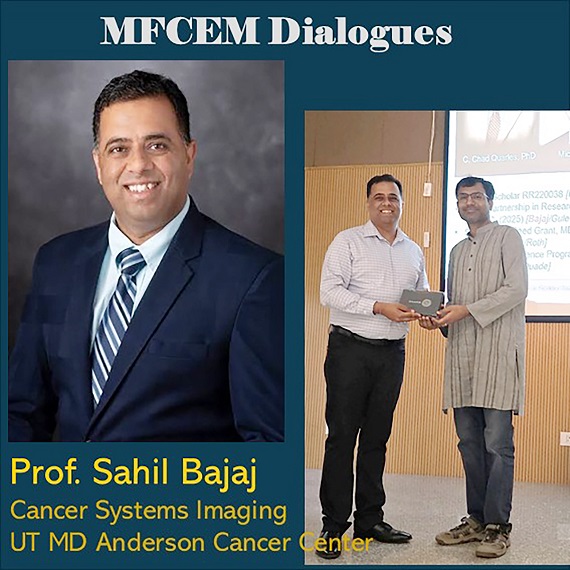
MFCEM Dialogues #15
by
Dr Sahil Bajaj,
Cancer Systems Imaging, Division of Diagnostics Imaging, The University of Texas MD Anderson Cancer Center
on
From Brain Mapping to Precision Health: AI and Neuroimaging Across Health and Disease
July 16, 2026
Dr. Sahil Bajaj is an assistant professor in the department of Cancer Systems Imaging at the University of Texas MD Anderson Cancer Centre in Houston; prior to which he was a research scientist and director of the Multimodal Clinical Neuroimaging Laboratory at Boys Town National Research Hospital, Nebraska. Dr Bajaj has received numerous awards and recognitions for his outstanding work. He was an honouree for Georgia State's 40 Under 40 Class of 2024, Georgia State University.
Dr. Sahil Bajaj is an assistant professor in the department of Cancer Systems Imaging at the University of Texas MD Anderson Cancer Centre in Houston; prior to which he was a research scientist and director of the Multimodal Clinical Neuroimaging Laboratory at Boys Town National Research Hospital, Nebraska. Dr Bajaj has received numerous awards and recognitions for his outstanding work. He was an honouree for Georgia State's 40 Under 40 Class of 2024, Georgia State University.
In his talk, Dr Bajaj, spoke about how artificial intelligence, biomedical imaging, and data science is transforming healthcare from a reactive, disease-centred model toward a predictive and personalized paradigm. He highlighted how current imaging technologies (such MRI and functional near-infrared spectroscopy) generates vast amounts of biological information, yet its translation into clinically actionable insights remains a major challenge.
Dr. Bajaj’s talk explored how advanced neuroimaging, machine learning, and computational approaches can be leveraged to develop objective biomarkers of human health, disease, resilience, and recovery. Drawing on examples from cancer survivorship, brain aging, cognitive health, and neurobehavioral outcomes, his presentation illustrated how AI can uncover hidden patterns within complex imaging datasets that are not readily detectable using conventional approaches.
Overall, Dr. Bajaj discussed a broader vision for AI-enabled biomedical imaging as a platform for precision medicine and spoke about future opportunities at the interface of engineering and medicine, including the development of digital biomarkers, and AI-driven decision-support systems capable of improving diagnosis, prognosis, treatment planning, and long-term patient care.
Post his talk Dr. Bajaj engaged in a vibrant conversation with students, sharing his academic journey and sharing the many opportunities in the field of AI and imaging.