Heat Transfer Laboratory

Address

Southern Laboratory-210

Overview

Heat transfer laboratory is an undergraduate teaching laboratory housing a handful of experimental setups pertaining to fundamental heat transfer problems and their applications. The experimental setups in this laboratory are a part of the curriculum for third-year undergraduate students undertaking the course “ME341A: Heat and Mass Transfer”. Listed below are the experiments performed by the enrolled students as part of their course:

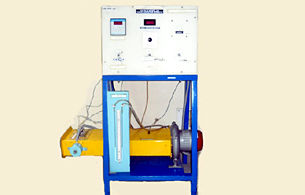
Pin Fin Apparatus: This setup is designed to study the heat transfer in a pin fin. It consists of cylindrical fin fitted to the base in rectangular duct. A blower is provided on one side of duct to conduct experiments under forced convection heat transfer mode. Five thermocouples are embedded along the axis of the cylindrical fin at five different locations and one thermocouple placed in the air stream at the exit of the test section to measure the outlet air temperature. Digital Temperature Indicator is provided to read temperatures distribution along the fin. Test pipe is connected to the delivery side of the blower along with the Orifice to measure flow of air through the pipe. A heater heats one end of fin and heat flows to another end. Heat input to the heater is given through variac. Students will be expected to develop the following skills/understanding upon the successful completion of this experiment:

  • Determine the temperature distribution along the length of a pin fin and the average heat transfer coefficient for the fin under forced convection configuration

  • Compute the effectiveness and efficiency of the pin fin

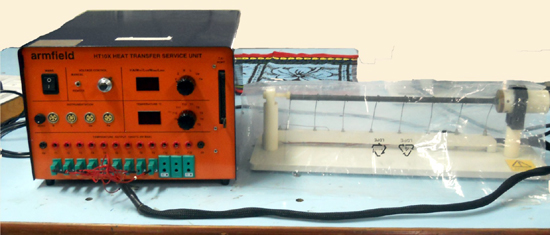
Heat transfer through extended surface: In this experiment heat transfer from the extended surface relies on natural convection and radiation. This experimental set up consists of HT15 extended surface heat transfer accessory alongside HT10X heat transfer service unit on a suitable bench. Power lead is connected from the HT15 to the HT10x heat transfer service unit. There are 9 thermocouples on the HT15 connected to the appropriate sockets on the front side of the service unit. Voltage controller, manual/remote switch, thermocouple selector and digital temperature indicator are provided on the front panel of the service unit. The following objectives are sought for by performing this experiment:

  • Establish the temperature distribution along the length of a tip-insulated extended surface and compare with analytical predictions

  • Compute the individual heat transfer coefficients over its periphery under the influence of both free convection and radiation heat transfer

  • Determine the thermal conductivity of the rod material using the observed data and computed heat transfer coefficients

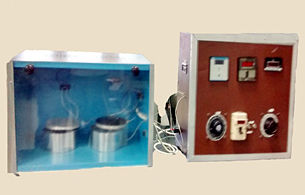
Measurement of emissivity: This experimental set up consists of two circular aluminium plates, plate one blackened by thick layer of lamp black to form the idealised black surfaces where as the plate 2 is the test plate whose emissivity is to be determined, identical in size and provided with heating coils at the bottom. The heat input to the heater is varied by separate dimmer stats and is measured by an ammeter and a voltmeter. Separate wires are connected to diametrically opposite points to get the average surface temperature and one thermo couple is placed in the enclosure to measure ambient temperature. The heater inputs to the two plates are dissipated by conduction, convection and radiation. The experimental set up designed in such a way that under steady state conditions the heat dissipated by conduction and convection in the same for the two plates.

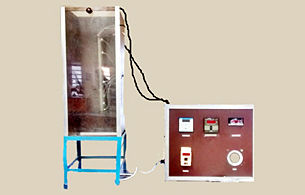
Heat transfer by natural convection: The setup consists of a brass tube fitted in a rectangular duct in a vertical fashion. The duct is open at the top and bottom, and forms an enclosure and serves the purpose of undisturbed surrounding. One side of the duct is fitted with a transparent good quality Acrylic window for visualization. An electric heating element is kept in the vertical tube that in turns heats the tube surface. The heat is lost from the tube to the surrounding air by natural convection. The temperature of the vertical tube is measure by Temperature Sensors and displayed by a digital temperature Indicator with multi-channel switch. The heat input to the heater is measured by a ammeter and a Voltmeter and is varied by a variac. The tube surface is polished to minimize the radiation losses.

  • Determine the heat transfer coefficient for heat loss via natural convection from a vertical, uniformly-heated (uniform heat flux) cylinder

  • Compare the experimentally obtained heat transfer coefficient with that estimated using a suitable empirical correlation

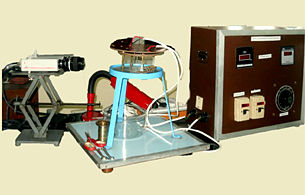
Critical heat flux measurement apparatus: This experimental set up is designed to study the pool boiling phenomenon up to critical heat flux point. The apparatus consists of a cylindrical glass container housing the test heater ad a hater coil for the initial heating of the water. This heater coil and test heater connected to mains via dimmer stats. An ammeter is connected in series while a voltmeter across it to read the current and voltage, respectively. The glass container is kept on an iron stand which could be fixed on a platform. There is provision of illuminating the test heater wire with help of a lamp projecting light from behind the container. A computer is facilitated for observing formation of bubbles and to identify the different regimes of pool boiling phenomenon. The following things can be studied by performing this experiment.

  • Obtain the value of critical heat flux for pool boiling of water under sub-cooled (varied degree of sub-cooling) and saturated conditions

  • Compare the experimentally obtained critical heat flux at the saturation temperature with that obtained using Zuber’s correlation

Unsteady state heat transfer:

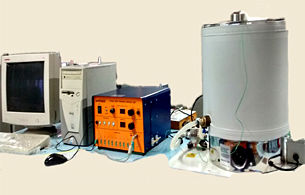
This experimental set up is used to observe unsteady state conduction of heat to the centre of a solid shape when a step change is applied to the temperature at the surface of the shape. This apparatus consists of a HT17 unsteady state heat transfer unit, a PC running windows with available USB socket and a HT10XC computer compatible heat transfer unit. The method of experiment is allowing solid shapes of different sizes, form and materials of construction to stabilise at room temperature and then dropped into a bath of hot water. The change in temperature at the centre of each shape is continuously logged using a PC connected to the HT10XC. The following objectives are pursued:


  • Estimate the heat transfer coefficient for a transient heat transfer situation from an isothermal working fluid to solid blocks of varied shapes made of a specific material

  • Determine the thermal conductivity of a material with the help of the known thermal conductivity and heat transfer coefficient for a similar shaped block but made of a different material

Thermocouple Calibration:

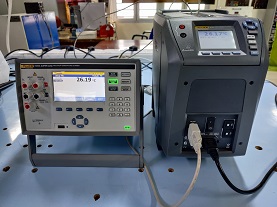
Thermocouple calibration is of paramount significance in obtaining accurate temperature measurements. In this experiment, Fluke's Field Metrology Well (FMW) – 9143 & Temperature scanner – 1586 A are used to calibrate in-house made J-type thermocouples for a range of temperatures (typically, 30-95º C). The LCD display of FMW–9143 is capable of continuously showing many useful operating parameters such as the block temperature, the set point temperature, and the heating and cooling status. This will ensure that no other data acquisition systems or a PC is needed for the completion of the experiment. The final outcome of the calibration will be presented as a plot of temperature (or, difference in temperature) vs thermocouple e.m.f. Following are the specific objectives of this experiment:


  • Make J-type thermocouples using a spot-welding machine

  • Develop a typical calibration curve for a J-type thermocouple using Fluke FMW 9143 dry well facility and a standard Fluke 5609 PRT

List of equipment

  • Pin Fin Apparatus

  • HT15 extended surface apparatus

  • HT10X heat transfer service unit

  • Emissivity measurement apparatus

  • Heat transfer in natural convection

  • Critical heat flux measurement apparatus

  • HT17 unsteady state heat transfer unit

  • HT10XC computer compatible heat transfer unit

  • Thermocouple spot welding machine

  • Fluke FMW-9143A dry well thermocouple calibration facility

Experiments

  • Heat transfer from a pin fin under forced convection heat transfer mode

  • Heat transfer from an extended surface under natural convection and radiation

  • Emissivity measurement

  • Natural convection heat transfer for a vertical tube

  • Pool boiling phenomenon up to critical heat flux point

  • Unsteady state heat conduction

  • Thermocouple calibration


Faculty: Dr. Umesh Madanan

Contact Person:
Mr. Farhan Babu [Lab staff]
Heat Transfer Laboratory (SL-210)
Phone: 0512-679-7987
Email: This email address is being protected from spambots. You need JavaScript enabled to view it.

Critical Heat Flux Apparatus

Thermocouple Calibration System


Unsteady Conduction Equipment

Emissivity Measurement Apparatus


Pin Fin Appratus

Natural Convection Heat Transfer Appratus


Extended Surface System


Manufacturing Science Lab

Teaching Laboratory

ME 361A: Manufacturing Technology

Overview:

Objective of this course is to give a broad understanding of conventional and non-conventional machining processes with an emphasis on the characterization techniques. This course also familiarizes students with the scientific principles governing various machining processes. 

Equipments

  • On Lathe- Lab VIEW Software, Three-component piezo-crystal type dynamometer make Kistler, NI DAQ Card, Microbalance, Dinolite USB Microscope, Vernier Calliper e.t.c.
  • On Grinding- Lab VIEW Software, Three-component piezo-crystal type dynamometer make Kistler, NI DAQ Card, Microbalance, Dinolite USB Microscope, Portable Surface Roughness Measuring Instrument etc.
  • On EDM – Electronica ZNC EDM Machine, Microbalance, Shadowgraph/ USB Microscope, Micrometer, Stopwatch, etc.
  • On Hydraulic Press- USB Microscope, Load Cell, Lab VIEW Software, NI DAQ Card, Vernier Calliper, Proving Ring etc.
  • On Microchannels fabrication- Microbalance, USB Microscope, Dessicator, vacuum pump, Furnace temperature upto 400 degree centigrade etc.
  • On Milling- Multi-component dynamometer make Kistler, Labview software, NI DAQ Card, Dinolite USB Microscope, Vernier Calliper, Microbalance etc.

Experiments:

  • To measure the cutting force, tool temperature and shear angle during orthogonal cutting (on Lathe).
  • To study the effects of grinding variables on grinding forces, specific energy and surface finish.
  • To study the EDM machine and determine material removal rate and tool wear rate during machining of EN8 steel.
  • To draw a cup by cup drawing process and measure the drawing force on hydraulic press.
  • To fabricate micro channels through micro Replication double inversion technique.
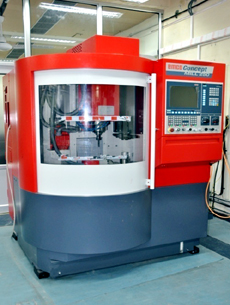
  • Investigation of wear and cutting processes (Fx, Fy, Fz and Mz) near the tool age during milling and drilling  by Rotating 4-Component Dynamometer (RCD) on EMCO Mill concept 250.
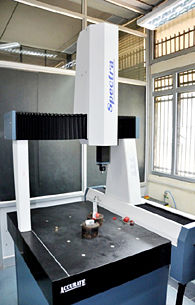
  • To obtain the measurement of a given component using coordinate measuring machine (CMM).
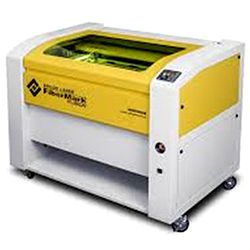
  • To fabricate micro channel through epilog laser fiber mark fusion engraving machine.
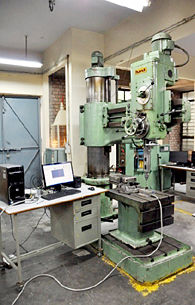
  • To measure the axial force, with tool speed for different diameters, if the feed is constant on HMT Radial Drill Machine.
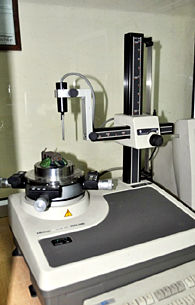
  • To obtain the measurement of roundness of a given component using Out of roundness measuring machine (Mitutoyo, Japan)
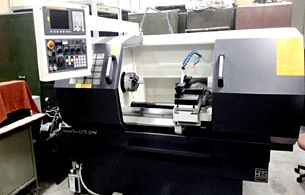
  • To measure the cutting force, shear angle during orthogonal cutting, cnc programming (Absolute/Incremental) and operations on flat bed Simple Turn5075 ACE Designer CNC Lathe Machine.
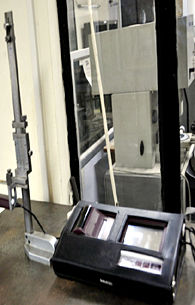
  • To study the various features of surface roughness measuring instrument also measure the parameters of the specimen.
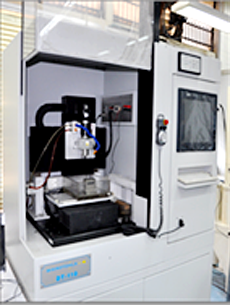
  • To study the integrated multi process (µ-milling, µ-turning, µ -drilling, µ-EDM, µ-ECM, µ-wire cut, µ-EDG) on micromachining machine DT-110.

Processing Equipment:
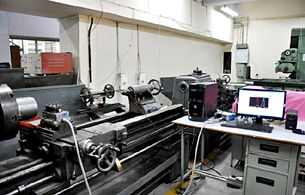
HMT LB-25 Centre Lathe:
Specification:
HMT LB-25 LATHE 500mm SWING x 2000mm BETWEEN CENTRES. 18 SPEEDS 32-1600 RPM. 52mm SPINDLE BORE WITH 3 JAW CHUCK, 4 JAW CHUCK, FACE PLATE, MULTIFIX QUICK CHANGE TOOLPOST.


Processing Equipment:
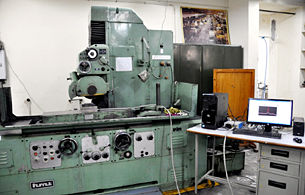
Horizontal Surface Grinding Machine
Make: HMT
Model: SFW1
Magnetic Chuck Size: 1000mm x 300mm
Accuracy: 2 μm
Table speed: 2.5, 5, 10, 15, 20, 25 (m/min)
RPM: 1500

Processing Equipment:
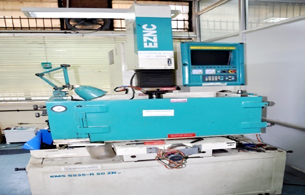
Electronica R50# ZNC
Work tank : 800 x 500 x 350 mm
Work table size: X Y Z : 300 x 250 x 200 mm
Programmable Z axis control, manually operated x and y axis.
Accuracy: 5µ
99 programs, 50 steps per program
Max. working current: 50A
Gap voltage: 100-270V
Max. Stock removal (cu-steel): 300(cu.mm/min)
Best surface finish: 0.5µ CLA
Electrode wear: 0.3-20%


Processing Equipment:
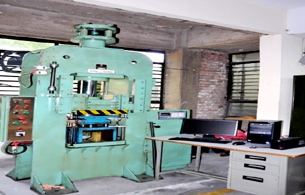
SPECIFICATION:
Make : Fluid Power
Type : Hydraulic
Bed Size : 500 mm x 500 mm
RAM Dia. : 12 mm"
Capacity : 10 T


Processing Equipment:
SPECIFICATION:
Model/Make: EMCO Concept Mill 250
Max Speed: 10,000RPM, Power 7KW
20 Station Tool Drum with directional logic
Travel- X350mm, Y250mm, Z300mm
Clamping Surface- 500x300mm
PC Controlled CNC –Machining center with Interchangeable control
EMCO Software Win NC
SINUMERIK 810/840D machine license (32bit)
Software EMCO 3D View
4th Axis- NC Dividing Head WALTER TANI 80 NEG
5th Axes- Turntable DSE25 èSpindle Speed A axis 15rpm;                         Spindle Speed B axis 3rpm;                Size- X/Y/Z = 520/260/150;               Swiveling Height =80MM;                      Swiveling Area of 4th Axis = Max. ±91o
ESPRIT CAM Software è Powerful Spectrum Programming for
2-5 Axis Milling,
2-22 Axis Turning, 2-5 Axis Wire EDM,
Multitasking Mill Turn Machining,
Swiss Turn and B-Axis Machine Tools High Speed 3 and 5- Axes Machining.

Characterization Equipment:
Coordinate Measuring Machine
Model: - Spectra 5.6.4. CNC
Scale Regulation = 0.5 μm
Machine accuracy = (± 2.5 + L/250) μm; (L: Standard length in mm)
Angular accuracy = 1” (One second)
Granite flatness = 2 micron per meter square
Granite grade = zero grade
Probing system = MS2DI
M/c version = CNC version
M/c working volume = X = 500 mm;   Y = 600 mm;  Z = 400 mm
Controller name = Renishaw UCC (Universal CMM Controller) lite-2 (U.K.)

Processing Equipment:
Epilog FiberMark Fusion
Size (W x D x H): 52.5" x 33.5" x 40.75"
(1334 x 851 x 1035 mm)
Engraving Area: 32" x 20"
(812 x 508 mm)
Focal Length (F-Theta Lens): 5" (127 mm)
Maximum Material Thickness: 11.25" (285 mm)
Laser Wattage 20, 30, or 50 watts
Laser Type: Solid State Pulsed Ytterbium Fiber Laser (air cooled)
Mode of Operation: Pulsed 20-80 kHZ.


Processing Equipment:
Hindustan Radial Drill Machine
Specification:
Make : HMT
Model : RM61
Spindle Capacity : 60 mm
Arm Length : 1200mm
RPM : 40,56, 80, 112, 150, 220, 300, 440, 580,
850, 1160, 1700


Characterization Equipment:
Mitutoyo RA-116 Round Test
Specification:
• Measuring and analysis software package ROUNDPAK running under Windows operating system
• Air-bearing turntable for high precision, wear-free rotation
• Accepts workpieces up to ø17.32" (440mm) diameter
• Turntable loading 20 kgf maximum
• Measurable diameter ø11.02" (280mm)
• Measuring range ±1000μm
• Measuring height for outside/inside diameters: 11.02" (280mm) maximum
• Measuring depth inside 3.94" (100mm) maximum (with standard stylus)
• Traverse of R axis 6.5" (165mm)
• Large centering range ±.12" (±3mm)
• Large levelling range ±1°


Processing Equipment:
ACE MAKE FLAT BED CNC LATHE MACHINE MODEL SIMPLE TURN 5075 WITH FANUC Oi MATE –TD CONTROL
Specification:
Swing Over Bed: Ø500
Swing Over the cross slide: Ø220
Maximum Turning Length : 650mm
Distance between Centers: 750mm
Spindle speed: 0-4000rpm
Spindle Motor Power: 11/7.5KW
LINEAR TOOLING
X Axis: 300mm
Z Axis: 700mm
Tailstock Quill Travel 180mm
Quill Taper: MT-5


Characterization Equipment:
Surface Roughness Measuring Instrument Specification:
Model SJ–301, Make: Mitutoyo
Measuring range
Z-axis 350 μm
X-axis 12.5 mm
Drive Unit Measuring: 0.25 mm/s; 0.5 mm/s
Speed Returning: 1.0 mm/s
Standard Probe (178-395)
Measuring Method Induction method
Stylus Diamond Tip: Radius 2 μm
Measuring Force 0.75 mN
Parameters: Ra, Rq, Rz
Cut-off-Length: 0.08 mm, 0.25 mm, 0.8 mm,
2.5 mm, 8 mm
Sampling Length: x 1, x 3, x 5, x L


Processing Equipment:
Mikrotools DT-110
Specification:
Work Table: 440 X 320
X & Y Axis Travel: 350 X 270
Z Axis Travel : 320+300
Max weight of the work piece: 350 kg
Work tank: 800 X 480mm
Connected load: 2 KVA
Max matching current: 20 amp.
Machine Footprint: 950 X 770 X 1950
Accuracy: 0.1 μm (100nm).


Characterization Equipment:
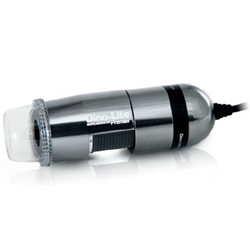
Dino-Lite Premier USB Microscope
Specification:
 Model: AM7013MZT4 Dino-Lite Premier
Interface: USB2.0
Resolution: 5Megapixel
Magnification Range: 20x-250x
Sensor: Color CMOS
Save Formats:
Image: BMP, GIF, PNG, MNG, TIF, TGA, PCX, WBMP, JP2, JPC, JPG, PGX, RAS, PNM DinoXcope: PNG, JPEG
Movie: WMV, FLV, SWF
DinoXcope: MOV
Polarizer and Measurement Function


Characterization Equipment:
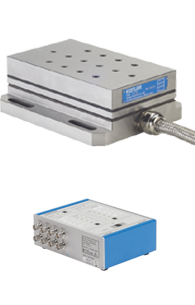
3-Component Dynamometer
Specification:
Dynamometer with handy size. Built-in charge amplifier with 4 measuring ranges switchable. Simple operation with control unit Type 5233A1.
Type 9257BA
External control unit for range selection and reset/operate. Signal output with 3 x BNC neg. and D-Sub 37-pin.
Type: piezo-crystal 
Forces: Fx, Fy and Fz with four miniature
Range: Fx and Fy 500N to 5KN
Fz: 1KN to 10KN


Characterization Equipment:
Rotating 4-Component Dynamometer (RCD)
Specification:
Make: KISTLER
Dynamometer Type 9123C
The dynamometer consists of a four component sensor fitted under high preload between a baseplate and top plate. The four components are measured practically without displacement.

Rotating 4-component dynamometer for measuring of cutting forces and torques on the rotating tool spindle. Transmission of measured data by telemetry hence without wear.
Speed      1/min         max. 10 000
Range 1 FSO Fx, Fy kN –5 ... 5
–3 ... 3
Fz kN –20 ... 20
Mz Nm –200 ... 200
Range 2 FSO (switchable) Fx, Fy  N –500 ... 500
Fz   kN   –2 ... 2
Mz  Nm  –20 ... 20
Sensitivity (Range 1) Fx, Fy  mV/N ≈ 2
Fz  mV/N ≈ 0,5
Mz mV/Nm ≈ 50
Forces: Fx, Fy, Fz and Mz


Characterization Equipment:
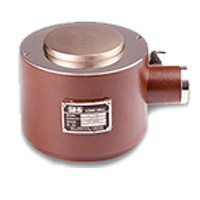
Column Load Cell
Specification:
Make: IPA
 Model: FC074H0
Type: Stain gauge based
Capacity: 70Ton
Gauge Resistance: 350 ohms nominal
Exitation voltage: 10v DC
Sensitivity: 1.5mV/V
Safe overload: 150% of rated load.
Resolution: 50Kg


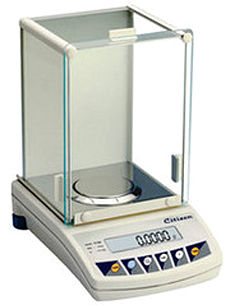
Characterization Equipment: Microbalance

Specification:
Make: CITIZEN 
Model: CY204
Capacity x Resolution (g): 220 g x 0.0001 g
Repeatability: 0.0001 g
Linearity: 0.0002 g
Response Time: 2 - 3 seconds
Units: g, mg, ct, GN, mo, oz, dwt
Platform Dimensions: 3.5" diameter
Sensor Type: Electromagnetic Force Compensation


Characterization Equipment:
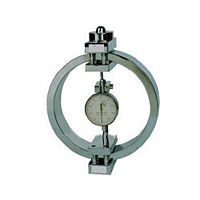
Proving Ring
Specification:
Make: HEICO 
Model: PR-302
Capacity: 5KN
Dial Gauge: ASAHI
Calibrated in: Compression

Characterization Equipment:

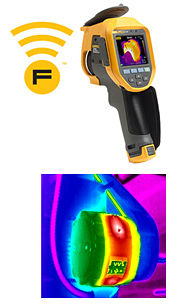
Fluke Ti400 Infrared Camera

Specification:
Make: FLUKE USA 
Model: TI-400
Temperature measurement range  : -20 °C to +1200 °C
Temperature measurement accuracy: ± 2 °C
Image capture frequency: 9 Hz refresh rate or 60 Hz refresh rate depending upon model variation
Detector type: Focal Plane Array, uncooled microbolometer, 320 x 240 pixels
Thermal sensitivity (NETD): ≤ 0.05 °C at 30 °C target temp (50 mK)
Total pixels: 76800
Minimum focus distance: 15cm


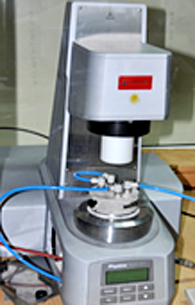
Characterization Equipment:Anton Paar Physica MCR301


Specification:

Technical Data  

Unit

MCR 302

Bearing


Air

EC motor


Yes

Maximum torque

mNm

200

Min. torque, rotation

nNm

1

Min. torque, oscillation

nNm

0.5

Angular deflection
(set value)

µrad

0.05 to ∞

Min. angular velocity

rad/s

10-9

Max. angular velocity

rad/s

314

Max. speed

1/min

3000

Min. angular frequency

rad/s

10-7

Max. angular frequency

rad/s

628

Normal force range

N

0.005-50

Normal force resolution

mN

0.5

Max. temperature range

°C

-150 to +1000


Characterization Equipment:

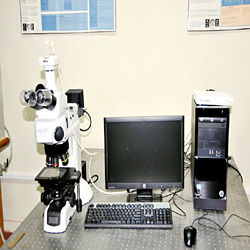
Nikon eclipse LV100 Industrial Microscope
Specification:
Model name: ECLIPSE LV100D
Magnification: 5x0.15, 10x0.30,
20x0.45, 50x0.80, 100x0.90 (LO plan fluor)
Optical system: CFI60 optical system
Illumination: Lamp ratings: 12 VDC, 50 W halogen lamp
Specified lamp: LV-HL50W 12V 50W halogen lamp
Specified lamp house: LV-LH50PC
Focusing mechanism: Stroke: 30 mm
Coarse focus knob: 14 mm/revolution
Fine focus knob: 0.1 mm/revolution
Eyepiece: 10x, field number: 22, 25
Operating environment: Temp: 0°C to +40°C
Relative humidity: 85% RH max.
Altitude: 2000 m max.
Pollution degree: Degree 2


Relevant Information (if any):
Faculty: Dr. J. Ramkumar (Lab Coordinator)
Staff: Mr. Sanjeev Kumar Verma,
Mr. Atul Kumar Gangwar
Contact Person: Mr. Sanjeev Kumar Verma
Location: NL-1-115A Manufacturing Science Lab., ME, IIT Kanpur
Phone: 0512-259-7923
Email: This email address is being protected from spambots. You need JavaScript enabled to view it.


Materials Testing Laboratory

Teaching Laboratory

ME 222: Nature and Properties of Materials

Overview:

Objective is to give a broad understanding of common materials related to mechanical engineering with an emphasis on the fundamentals of structure-property-application relationships.

Course Content:

History of engineering materials, Engineering materials, Materials property chart, Crystal structure, Imperfections of solids, Mechanism of strengthening in metals, Hall-Petch effect, Xray diffraction, Fracture: Ductile, brittle, fatigue. Griffith criterion, S-N curve, Creep, Phase diagram (binary), Iron-carbon system, Heat treatment of metals, Electrical properties, Thermal properties, Magnetic properties, Optical properties, Corrosion, Oxidation, Thermal stability ,
Wear, abrasion, friction of materials, Characterization techniques: Optical microscopy, scanning electron microscopy, transmission electron microscopy, atomic force microscopy, Polymer and its characterization, Viscoleasticity, Nanomaterials and its important properties at nanoscale, Composites: Characterization of composites, Ionic polymer matrix composites, Shape memory alloy, Intelligent Multifunctional materials, Economics, Environment, and
Sustainability In addition to the lectures, the course is associated with a laboratory session. A group of 6/7 students can conduct experiment effectively. A total of six experiments for the duration of 2 hours each is proposed for this course.


Processing Equipment:

Environmental Controlled High Temperature Furnace: Heat treatment  in controlled atmosphere
Specification:

Temperature: Room temperature to 1400 0C
Heating rate : 0.5 0C/min to 10 0C/min
Environment : Air, Nitrogen, etc

Location: ACMS 207B


Processing Equipment:

Specimen Cutting Machine-  Metallic, polymer, etc
Specification:

RPM- 1500 max

Wheel size: 33 x 2 x 32 mm

Sample size (max): 30 mm x30 mm

Location:ACMS 203B


Processing Equipment:

Single/Double Disc Polishing Machine- Polishing of samples to get smooth surface finish

Specification:

Diameter of disc: 200 mm
Rotation: 300-650 rpm

Location: ACMS 203B


Characterization Equipment:

Universal Testing Machine- Studies of strain-strain behaviour of materials

Specification:

Max force- 100 kN
Cross head speed- 5 mm/min to 100 mm/min
Travel length- 450 mm
Test types- Tension, Compression, and Flexural

Location: NL-1, Room # 112


Characterization Equipment:

MTS 810 Testing Machine- Studies of mechanical properties of materials

Specification:

Max. Force- 100 kN
Travel length- 1308 mm
Controller: Flex test 40
Test types: Tension, compression, bending, and cyclic fatigue


Location: NL-1, Room # 112


Characterization Equipment:

Rotating Beam Fatigue Tester: Studies of fatigue life and endurance limits of metals

Specification:

Load- 10 Kg to 40 Kg
RPM – 1420

Location: ACMS, Room # 207B


Characterization Equipment:

Rotating Beam Reverse Bending Fatigue Testing Machine- Studies of fatigue life and endurance limits of metals

Specification:

RPM- 2800 - 6000
Load- 0.5 kg – 4 Kg
Sample- Dumbbell shape
Diameter of specimen: 8 mm

Location: ACMS 207B


Characterization Equipment:

Rotating Beam Reverse Bending Fatigue Testing Machine - Studies of fatigue life and endurance limits of metals

Specification:

Diameter of test specimen: 8 mm Maximum bending moment:  500 Kg. cm.
RPM- 1425
Load- 0.250 Kg to 50 Kg

Location: ACMS 207B


Characterization Equipment:

Shore A Durometer- Measurement of hardness for soft materials like rubber

Specification:

Preload: 0.45 Kgf
Major Load: 8.06 N
Indentor type- 35° truncated cone indenter
Type of load- Constant contact pressure

Location: ACMS 207B


Characterization Equipment:

Shore D Durometer- Measurement of harness for hard polymer

Specification:

Preload: 0.45 Kgf
Major Load: 44.48 N
Indentor type- 30° cone indenter
Type of load- Constant contact pressure

Location: ACMS 207B


Characterization Equipment:

Portable Hardness Tester- Rockwell hardness tester for measurement of hardness

Specification:

Rockwell test
Load – 10 Kg, 60 Kg,  100 Kg and 150 Kg
Indentor: Diamond /
1/16” ball

Location: ACMS 207B


Characterization Equipment:

Poldi Hardness Tester- Measurement of hardness

Specification:

Preload: 0.42 Kgf
Major Load: Hammer blow
Material -  Alloy steel EN-8 OR EN-9
Dia- 30mm
Length- 85 mm
Tungsten Carbide Ball
Dia- 10 mm
Poldy Bar
Material: Alloy steel EN-8 or EN-9 or Carbon Steel- WPS
Size- 12 mm X 12mm X 150 mm
Eyepiece- 8X, 25 X

Location: ACMS 207B


Characterization Equipment:

Ellipsometer- Thickness of thin film

Specification:

Range: 10 nm – 400 nm
Source – Green laser, 532 nm

Location: ACMS 203F


Characterization Equipment:

Metallography Station Trinolcular Optical Microscope with Camera- To study surface morphology

Specification:

Magnification- 25 X to 1200X
Focusing: Coarse to fine
Head: Monocular, binocular/trinocular
Illumination- Halogen, incident light
Eye piece: 5X, 10X, 15X and 20 X
Objective: 5X, 10X 20X and 40X

Location: NL-1, Room # 112


Characterization Equipment:

Surface Roughness Tester- Measurement of surface hardness

Specification:

Range: 350 m (-200 m to 150 m)
Detecting mode: Skid measurement
Measuring force: 4mN or 0.75 mN (Low force type)
Stylus tip: Diamond, 900/mR (600/2mR: low force type)
Travelling length : 6 mm
Evolution length (mm) : 1.25,  4.0

Location: ACMS 207B


Characterization Equipment:

Superficial Rockwell Tester

Specification:

Range: 350 m (-200 m to 150 m)
Detecting mode: Skid measurement
Measuring force: 4mN or 0.75 mN (Low force type)
Stylus tip: Diamond, 900/mR (600/2mR: low force type)
Travelling length : 6 mm
Evolution length (mm) : 1.25,  4.0

Location: ACMS 207B


Characterization Equipment:

Brinell Hardness Tester- Brinell hardness test of Metals

Specification:

Preload: 250 Kgf
Major Load - 250-3000 Kgf in range of 250 Kgf
250, 500, 750, 1000, 1250, 1500 Kgf
Maximum test height- 410 mm
Depth of throat- 205 mm
Max depth of spindle below base – 180 mm
Steel ball diameter (Indentor)- 10 mm , 5 mm, 2.5 mm

Location: ACMS 203B


Characterization Equipment:

Vickers Hardness Tester- Vickers hardness tester of metals

Specification:

Load- 5 Kgf to 50 Kgf
30, 40, 50 Kgf (loads 5, 10, 15, 20 not working properly)
Indentor – diamond
Magnification- 25 X

Location: ACMS 203B


Associate Faculty: Prof. Kamal K. Kar, Prof. Bishakh Bhattacharya, Prof. J. Ramkumar

Staff: Mr. Suresh Chendra

Contact Person: Mr. Suresh Chendra


Mechanics Laboratory

Address:


Room No 204 NL1
Dept. of Mechanical Engg.
I.I.T., Kanpur
Kanpur 208016

Overview:


This lab is used for the ME352 course (ME 352).

1. MAKIT – Master Kit


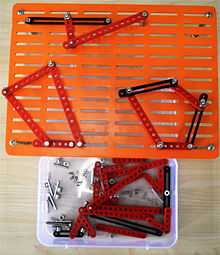
Makit - Master is a collection of precision mechanical components which are handy & flexible. These components can be used for building Mechanisms like slider crank, whit worth quick return mechanisms, walking mechanisms and pantograph copying mechanisms and so on. By utilizing these components anybody can build verities of machine prototypes & later on it can be transformed in to real working models. These comprehensive components has wide verities of Machine elements & there is lot of room for the testing of creative ideas and even one can even draw the coupler curves with the help of pencils and drawing boards provided in the kit. Which will be useful for doing lot of research work regarding the mechanisms and their movements instantaneously Makit - Master is an asset to kinematics, Mechatronics & Robotics lab's to carry out all types of project works, experiments & research work using various kit components like links, shafts, spur gears, bevel gears, couplings, etc,.


2. Epicyclic Gear Train Apparatus


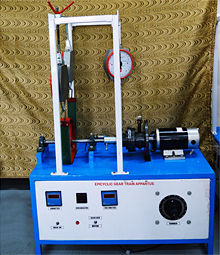
Any combination of gear wheels by means of which motion is transmitted from one shaft to another shaft is called a gear train. In case of epicyclic gear trains, the axes of the shafts on which the gears are mounted may move relative to a fixed axis. This experimental apparatus consists of sun and planetary gear box with a sun gear (14 teeth) and two planet gears (21 teeth each), rope and spring balance arrangement to measure output torque and holding torque, 1 H.P. D.C. shunt motor, 3000 RPM, 230 V, control panel with dimmerstat (DC) for speed variation and ammeter and voltmeter.


3. CAM Analysis Machine


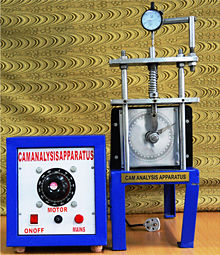
The machine is a motorized unit a camshaft is driven by a D.C. Motor. The shaft runs in a double ball bearing. At the end of the cam shaft a cam can be easily mounted. As the follower is properly guided in gun- metal bushes and the type of the follower can be changed to suit the cam under test. A graduated circular protractor is fitted coaxial with the shaft and a dial gauge can be fitted to note the follower displacement for the angle of cam rotation. A spring is used to provide controlling force to the system. Weights on the follower rod can be adjusted as per the requirements. An arrangement is provided to vary the speed of camshaft. The machine is particularly very useful for testing the cam
performance for jump phenomenon during operation. The machine clearly shows the effect of change of inertia forces on jump action of cam follower during the operation.


4. Static & Dynamic Balancing Machine


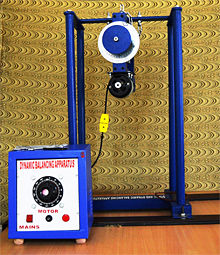
The apparatus consists of a steel shaft mounted in ball bearings in a stiff rectangular mainframe. A set of four blocks of different weights is provided and may be detached from the shaft. A disc carrying a circular protractor scale is fitted to one side of the rectangular frame. A scale is provided with the apparatus to adjust the longitudinal distance of the blocks on the shaft. The circular protractor scale is provided to determine the exact angular position of each adjustable block. The shaft is driven by electric motor mounted under the main frame, through a belt. For static balancing of weights the main
frame is suspended to support frame by chains then rotate the shaft manually after fixing the blocks at their proper angles. It should be completely balanced. In this position, the motor driving belt should be removed. For dynamic balancing of the rotating mass system, the main frame is suspended from
the support frame by two short links such that the main frame and the supporting frame are in the same plane. Rotate the statically balanced weights with the help of motor. If they rotate smoothly and without vibrations, they are dynamically balanced.


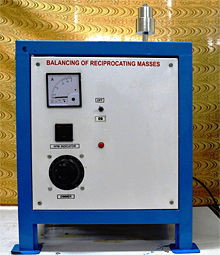
5. Balancing of Reciprocating Masses Apparatus


The apparatus is designed to demonstrate the effect of unbalanced mass in reciprocating motion. The apparatus consists of a simple cylinder, piston and connecting rod arrangement. The piston, driven by the motor, reciprocates in the cylinder. The motor is coupled with connecting rod. Speed of the motor can be varied with the help of dimmerstat. Initially the total system is in completely balanced condition. That is, the piston is reciprocating smoothly in the cylinder without extracting any extra current from the motor. This can be visualized on the ammeter. If the system is made unbalanced by putting some extra weight on the piston, immediately it will start to extract extra current from the motor. This change in current can be observed on the ammeter. The speed of the connecting rod can be measured by using RPM indicator.


MAKIT – Master Kit


Epicyclic Gear Train

Apparatus


CAM Analysis Machine


Static & Dynamic Balancing

Machine


Balancing Of Reciprocating

Masses Apparatus


Lab 1. Develop the understanding of different types of links, joints, mechanism, its actions and curve traces by making Peaucelliar-Lipkin Linkage, Watts, Pantograph and a four bar mechanism with a translational link using the kit provided.

Lab 2. Understand Grashof Criterion, its inversions, form Grashof, non-Grashof Mechanism and all possible cases of its mechanism and inversions using the kit provided.

Lab 3. Measure the input, output and holding torque using spring balance to study torque relationship and verify the correlation between speed and torque in epicyclic gear train.

Lab 4. Draw the cam profile from the observed (deg/ displacement) and compare it with the actual profile.

Lab 5. Balanced a simple rotating mass system (a) Statically by randomly orienting two masses and analytically solve to get the orientation of rest of two masses. (b) Dynamically by statically balancing the masses along the length of the rotor such that the net moment become zero.

Lab 6. (a) Balanced a simple rotating mass system using 2 Plane Balancing approach by placing two masses at specified positions and orientations and analytically solve to get the orientation of rest of two masses at pre specified plan along the length of the rotor.
(b) Observe reciprocating unbalance by adding masses to the pre balanced system.


Equipment:


1. MAKIT – Master Kit
2. Epicyclic Gear Train Apparatus
3. CAM Analysis Machine
4. Static & Dynamic Balancing Machine
5. Balancing of Reciprocating Masses Apparatus


Relevant Information (if any):


Any other useful information, lab resources (notes, videos, etc.)

Faculty: Prof. Bhaskar Dasgupta (Coordinator)

Staff: Mr. Gyanendra Prakash Tripathi

Contact Person:

Mr. Gyanendra Prakash Tripathi
Location: Room No 102
NL1
Dept. of Mechanical Engg.
I.I.T., Kanpur
Phone: 0512-259-7913
Email: This email address is being protected from spambots. You need JavaScript enabled to view it.