MEMS Fabrication


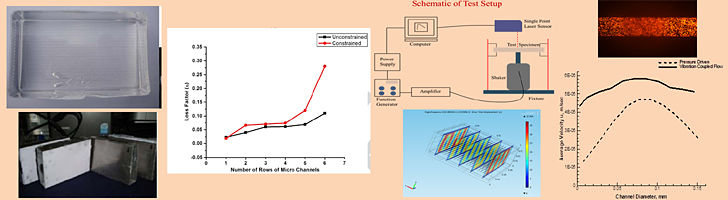
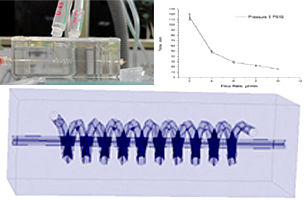
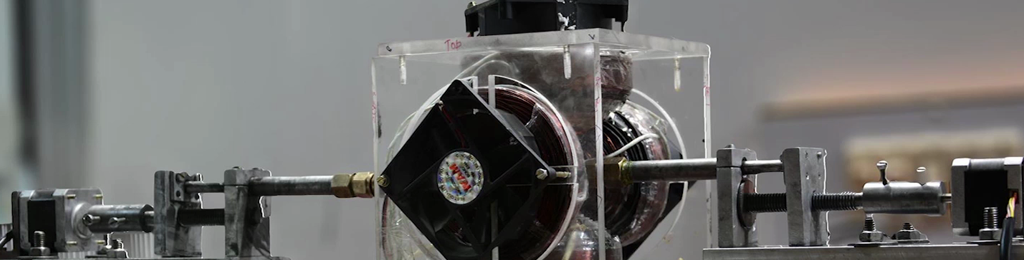
A Passive Vibration micro-damper


The resarchers in MEMS fabrication area develop microscale technologies for applications in the physical and biomedical sciences. Focus areas in the group include MEMS fabrication for microfluidics and integrated micro- and nano-sensing, fabrication and testing of an integrated biochip.

Research Areas


MEMS fabrication for microfluidics and integrated micro/ nano sensing, fabrication and testing of an integrated biochip, microscale flow initiation and behavior, polymeric DNA microchip, nanofabricated gas sensors, carbon nanotubes, nanopolymers


Research Laboratories:


Micro systems Fabrication Laboratory


Associated Faculty


S. Bhattacharya, PhD (University of Missouri, Columbia): Bio MEMS, Lab on Chip, Nano Technology, Microsystems Fabrication and MicroFluids

Niraj Sinha, PhD (University of Waterloo, Canada): Nanotechnology, Bioengineering, Manufacturing systems


Piezo-based micro pump


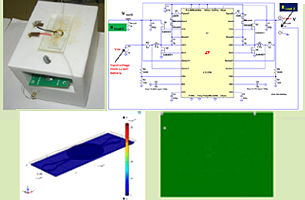
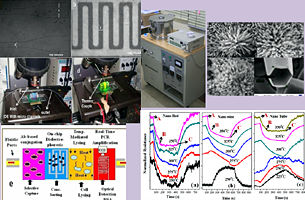
MEMS fabrication for Microfluidics and Integrated Micro/Nano sensing


Solenoidal Microvalves


Rohit Kumar Singh

Designation:

Junior Technician

Office Address:

Vibration & Dynamics Lab (NL-103, NL-101)

Contact numbers:

0512-2596097,7983 (O), 08009956360 (Mob)

  • Worked with Prestair Systems Pvt. Ltd as a Trainee from July 2009 to Dec 2009.

  • Worked with KSW Scientific Pvt. Ltd as Production Engineer Dec 2009 Dec 2009.

  • Completed Vibration & Dynamics Lab Class for UG students from 2010 with measurment and instruments for theses experiments.

  • Working jointly to conducting Vibration Lab and research along with Dr. Nalinaksh.S.Vyas, Late Dr. H. Hatwal, Dr. Bishakh Bhattacharya , Dr. S.S.Gupta and Dr. Panka Wahi from the Academic year 2009 to till date.

  • Conducted a short term course for NVH Workshop with Prof. Bishakh Bhattacharya for Department of Mechanical Engineering Indian Institute of Technology Kanpur in 2011-12.

  • Conducted a modular course for entire semester for Design programme students of Indian Institute of Technology Kanpur 2013-14 with Prof. Bishakh Bhattacharya.

  • Deisned a Vortex Induced Vibration Demonstration setup for UG Student with Late Prof. H. Hatwal and now trying to built a computer interface software for same in next level.

  • Applied Joint Patent with Prof. Bishakh Bhattacharya for Adaptive Vibration Energy Harvesting Device (VEHD). This is also a part of my joint research work for MDES programme at Design Programme, Indian Institute of Technology Kanpur .

  • Successfully completed a Joint Research work on Design development and testing of a Energy Harvesting Device using Vibration at Graduate School of Information Production Systems ,WASEDA University Japan under the Guidance of Prof. Harutoshi Ogai and Prof. Bishakh Bhattacharya in the year 2014 and subsequent work is to be continued further.

  • Submitted modified Adaptive Vibration Energy Harvesting Device (AVEHD) with all modification completed for joint patent in the year 2015.

  • Knowledge of fabrication skill Data acquisition with virtual instrumentation which is required for executing new set-ups for Research/M. Tech/P.hD experimental work.

  • Conducted a short term modular course in Vibration lab for Engineering Mechanics Workshop for IIT Kanpur with Prof. S.S.Gupta in the year of 2015.

  • Founder Member of RuTAG Indian Institute of Technology Kanpur.

  • Part Time student of Design Programme Indian Institute of Technology Kanpur.

  • Student member of SMSS Lab Indian Institute of Technology Kanpur.

  • Research Alumuni and active member of Ogai Lab Graduate School of IPS Waseda Japan.


B. Tech.

The Bachelor of Technology (B. Tech.) in Mechanical Engineering is a 4 year program comprising of 8 semesters.

The undergraduate degree programs in Mechanical Engineering have a strong flavor on design and hands-on experience. The programs include a deeper study of a number of engineering sciences to which students are introduced at the core curriculum level, theoretical and experimental solution of physical problems, and design of systems relevant to the contemporary industries. The areas introduced by the department include Energy Conversion and Power Systems, Heat Transfer and Fluid Mechanics, Mechanics of Solids, Manufacturing Science, Industrial Engineering, Automatic Controls and Engineering Design and Optimization. Besides the theoretical and laboratory based curriculum, students complete an advanced design project in the final year of the program.

1st Semester

2nd Semester

MTH101A [11]

MTH102A [11]


PHY102A [11]/

PHY103A [11]/

PHY103A [11]

PHY102A [11]


PHY101A [03]/

CHM101A [03]/

CHM101A [03]

PHY101A [03]


TA101A [09]

ESC101A [14]


LIF101A [06]

CHM102A [08]


ENG112A/HSS‐1

PE102A [03]

(Level‐1) [11]


PE101A [03]


54

50


3rd Semester

4th Semester

ESC201A [14]

HSS‐2 (Level‐1) [11]


ESO/SO‐1

ESO/SO‐5

ESO201A [11]

ESO202A [11]


ESO/SO‐2

ESO/SO‐6

ESO209A [08]

ESO203A [13]


ME251A [05]

ME222A [07]


TA202A [06]/
TA201A [06]

ME231 [10]


ESO/SO‐3

COM200A [05]

MSO202a [06]


ESO/SO‐4

TA201A [06]/


MSO203B [06]

TA202A [06]


56

63


5th Semester

6th Semester

HSS‐3 (Level‐2) [09]

HSS‐4 (Level‐2) [09]


ME301A [06]

ME341A [10]


ME321 [07]

ME351A [08]


ME352A [07]

ME354A [10]


ME361A [10]

OE‐2 [09]


ME399A [02]

DE‐1 [09]


OE‐1 [09]

UGP‐1 [04]


(ME398A)
(Extra Credits)

50

55/59


7th Semester

8th Semester

HSS‐5 (Level‐2)
[09]/ DE‐2 [09]

DE‐2 [09]/ HSS‐5
(Level‐2) [09]


ME401A [10]

ME461A [09]


ME451A [09]

ME452 [06]

(UGP‐2)

(UGP‐3)


OE‐3 [09]

OE‐4 [09]/DE‐3 [09]


OE‐4 [09]/

OE‐5 [09]

DE‐3 [09]

UGP‐4 [09]

OE‐6 [09]

(ME498A)

(Extra Credits)


46/55

51


Minimum credit requirement for graduation

  • Institute Core (IC): 124 Credits

  • Department Compulsory (DC): 101Credits

  • UGP‐2 and UGP‐3: 15 Credits

  • Department Elective (DE): 27 Credits

  • Open Elective (OE): 54 Credits

  • ESO/ SO: 55 Credits

  • HSS (Level‐I): 22 Credits

  • HSS (Level‐II): 27 Credits

Remarks:

1) UGP‐2 (ME451A) and UGP‐3 (ME452A) are departmental compulosry courses for B. Tech. students. However, these are optional for BT‐MT students who apply for conversion to BT‐MT program before the end of the sixth semester. Such students may do any two DE PG courses as substitute for UGP‐2 and UGP‐3. If a student opts to take ME451A or ME452A after applying for the dual degree programme before the end of the 6th semester, these courses WILL NOT count towards his/her DE‐PG requirement .

2) Students registering for ME451A (UGP‐2) must form BTP groups and inform Convener, DUGC, by April 30th of 6th Semester.

3) ME students applying for BT‐MT in ME after the formation of BTP groups will have to take UGP‐2 and UGP‐3. Neither of these courses may be dropped. Out of UGP‐2 and UGP‐3, only UGP‐3 may be counted towards DE‐PG credits for these students.

4) UGP‐1 & UGP‐4 are optional and do not count towards graduation requirements.

5)15 credits of UGP‐2&3 and 18 OE credits may be waived from the minimum BT requirements for students opting for dual degree in ME itself.

6) Upto 36 OE credits may be waived from the minimum requirements for students opting for Dual Degree in any other department or the Double Major programme.


B. Tech. – M. Tech. Dual Degree

The Bachelor of Technology – Master of Technology (B. Tech. -M. Tech.) in Mechanical Engineering is a five-year program comprising of ten semesters. Both the degrees and B. Tech. for those students who do not meet the academic requirements for the award of M. Tech. degree, are awarded at the end of five years or whenever the requirements have been completed thereafter.

Students of the B. Tech.- M. Tech. (Dual degree) program spend their first seven semesters doing undergraduate courses together with the students of the B. Tech. program, while the last three semesters are spent doing postgraduate courses together with the students of the M .Tech. program. At the end of five years, they graduate, receiving both B. Tech. and M. Tech. degrees together. There is no option of early exit with a B. Tech. degree only. Students in this program who have good academic performance are given a scholarship in the final year, which is on par with that given to students of M. Tech. program.

The B. Tech. – M. Tech. dual degree program has been designed to make it attractive for a good student to do an M. Tech., and thus contribute to the research efforts of the department. The student benefits by getting an M. Tech. degree with just one year of extra effort, thereby saving at least six to twelve months.

The current B. Tech. students, both from Mechanical Engineering and outside Mechanical Engineering, are allowed to change to dual degree M. Tech. program in Mechanical Engineering.


7th Semesters

8th Semesters

9th Semesters

10th Semesters

DE PG‐1 [09]

DE PG‐4[09]

M.TECH. THESIS [36]

M.TECH. THESIS[36]

DE PG‐2[09]

DE PG‐5[09]

DE PG‐3[09]/OE PG‐1 [09]

DE PG‐6[09]/OE PG‐1 [09]


27

27

36

36


Minimum Credit Requirement in M. Tech. part for Graduation

PG Component: 54 Credits
Thesis Component: 72 Credits


Remarks:

1) UGP‐2 and UGP‐3 are compulsory for UG ME students, but not for BT‐MT ME students. BT‐MT ME students have to take 18 credits of DE PG instead o students applying for BT‐MT in ME after the start of 7th semester will have to take UGP‐2 and UGP‐3. Neither of these courses may be dropped. Out o towards DE‐PG credits. In that case, students will have to make up the remaining 12 credits of DE PG with additional PG level ME courses.2) All courses to be taken with the permission of Supervisor/ DUGC Convener.

3) AE675A may count as DE PG in lieu of ME623A. Similar equivalences can be established by the DUGC after deliberating the course content on a case to case basis.

4) Course credits and Thesis credits mentioned under the dual degree template are only for the M.Tech. part of the programme. In addition to the complete all their graduation requirements for their UG programme.

5) Upto 18 OE credits may be used from the BT minimum requirements to fulfil requirements for the BT‐MT dual degree programme. These will b towards PG requirements.


Specialization

Compulsory Course Credits

Elective Credits

Thesis Credits


SOLID MECHANICS AND DESIGN (SMD)

ME621A [09]

DE PG‐1 [09]

M.TECH. THESIS [72]


ME625A [09]

DE PG‐2 [09]

M.TECH. THESIS [72]


ME681A [09]

DE PG‐3 [09]

M.TECH. THESIS [72]


FLUID & THERMAL SCIENCES (FTS)

ME631A [09]

DE PG‐1 [09]

M.TECH. THESIS [72]


ME641A[09]

DE PG‐2 [09]

M.TECH. THESIS [72]


ME642A [09]


M.TECH. THESIS [72]


ME681A [09]


M.TECH. THESIS [72]


MANUFACTURING SCIENCES (MFS)

ME661A [09]

DE PG‐1 [09]

M.TECH. THESIS [72]


ME662A [09]

DE PG‐2 [09]

M.TECH. THESIS [72]


ME663A [09]


M.TECH. THESIS [72]


ME681A [09]


M.TECH. THESIS [72]


Minimum Credit Requirement in M. Tech. part for Graduation

PG Component: 54 (27 compulsory + 27 electives) Credits for SMD
PG Component: 54 (36 compulsory + 18 electives) Credits for FTS and MFS
Thesis Component: 72 Credits


Remarks:

1) All courses to be taken with the permission of Supervisor/ DUGC Convener.2) Some of the compulsory courses in any of the above streams may be replaced with DE PG by the DUGC Convener based on the UG courses done by th3) Course credits and Thesis credits mentioned under the dual degree template are only for the M.Tech. part of the programme. In addition to thes complete all their graduation requirements for their UG programme.4) Upto 36 OE credits may be used from the parent department's BT/BS minimum requirements to fulfil requirements for the BT/BS‐MT dual degree prog department's BT programme requirements and counted towards PG requirements.