


Decades of surface observations reveal our Sun’s mysterious magnetic interior
Decades of surface observations reveal our Sun’s mysterious magnetic interior
Kanpur , 22 January 2026
Source: Information and Media Outreach Cell, IIT Kanpur
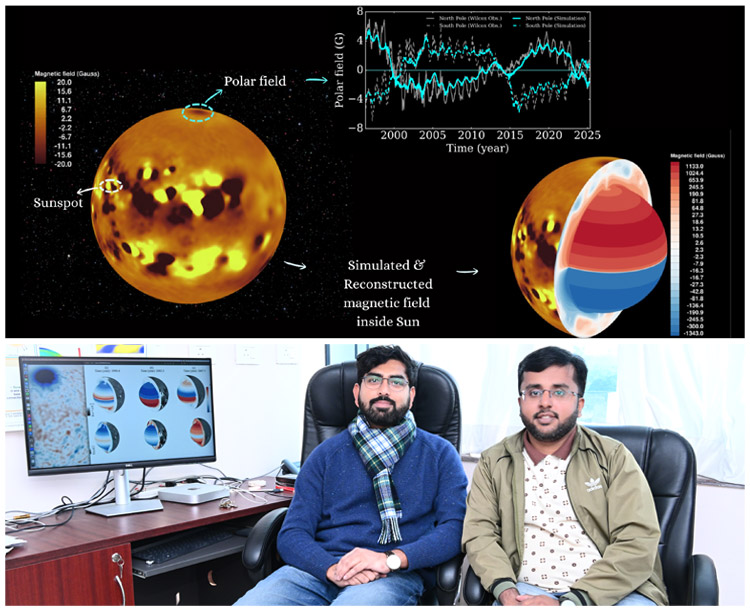
Kanpur, January 22, 2026: Researchers at IIT Kanpur map the magnetic field inside the Sun for the first time by combining 30 years of surface observational data from space satellites into a 3D computational model. This study provides an unparalleled estimate of the magnitude, structure, and evolution of magnetic fields inside the Sun over three decades, which is tremendously important for understanding how our Sun drives space weather that disrupts satellites, radio communication, navigation, and technological assets. Understanding solar magnetic activity is essential for explaining and predicting space-weather events that can disrupt satellites, power grids, navigation, and communication systems on Earth. This activity does not remain constant: it rises and falls roughly every 11 years, following a regular magnetic cycle that governs the appearance of sunspots and solar eruptions.
The physical mechanism behind this cyclic behaviour is the solar dynamo - a process through which the Sun generates its magnetic field deep within its interior. Since this region lies hidden beneath the solar surface, scientists cannot observe it directly. Although modern instruments can measure the solar surface magnetic field in unprecedented detail, the inaccessibility to probe the solar interior has long limited efforts to estimate the magnitude and behaviours of the magnetic field inside the Sun. The unavailability of a proper estimate of the solar magnetic field inside the Sun is one of the major bottlenecks to testing and refining theories of how the solar dynamo operates.
A recent study published in The Astrophysical Journal Letters, led by Soumyadeep Chatterjee, a PhD student, together with his supervisor Prof. Gopal Hazra from the Department of Physics, IIT Kanpur, takes a step towards addressing this challenge. The researchers developed a three-dimensional dynamo model that assimilates a huge amount of long-term observational data of the solar surface magnetic field for three decades. Combining all 30 years of surface magnetic field data into a 3D computational model, the study examines how large-scale, average magnetic patterns evolve over time and map the entire three-dimensional magnetic field inside the Sun. The idea is that if magnetic fields deep inside the Sun play a dominant role in shaping surface magnetism, then traces of these internal fields should persist in surface observations collected over long periods.
One of the key strengths of this approach is its strong reliance on observations rather than purely theoretical simulations. By anchoring their model to real data, the researchers are able to place meaningful constraints on the magnitude, structure, and evolution of magnetic fields beneath the solar surface. The model is validated using observations of the solar polar magnetic field - a widespread field near the poles that is known to provide an important indication of the strength of the next solar cycle.
The researchers further suggest that their approach is very robust for predicting the peak of the next solar cycle and much more realistic than any other predictive models of the solar cycle. This study also shows that the computational model combined with big observational data is the future of the field, and it is extremely important to improve long-term planning to protect space missions and technologies against solar activity.
For more information, click the link here: https://doi.org/10.3847/2041-8213/ae3138
About IIT Kanpur
The Indian Institute of Technology Kanpur, established in 1959, holds the distinction of being recognized as an Institute of National Importance by the Government of India through an Act of Parliament. Renowned for its excellence in science and engineering education, IIT Kanpur has made significant contributions to research and development over the decades. Its expansive, lush green campus spans 1,050 acres and hosts a rich array of academic and research resources. The institute comprises 19 departments, 20 centers, three interdisciplinary programs, and three specialized schools across engineering, science, design, humanities, and management disciplines. With over 590 full-time faculty members and more than 9,500 students, IIT Kanpur remains a leader in fostering innovation and academic rigor.
For more information, please visit: www.iitk.ac.in.
