Formal Faculty


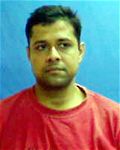
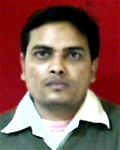
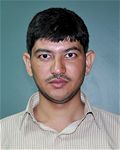
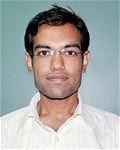
Sivasambu Mahesh (PhD, Cornell University) (On Leave)
Associate Professor, Mechanical Engineering

AE 114 (Faculty Building)
0512-259-7060 (O)
0512-259-8133 (O)
E-mail: This email address is being protected from spambots. You need JavaScript enabled to view it.
Personal homepage

Research Interests
Solid Mechanics, Composite Materials and Manufacturing Processes.


Research Scholars

Anand K.
E-mail: This email address is being protected from spambots. You need JavaScript enabled to view it.
Stream: Fluid and Thermal Science
Supervisor: S. Sarkar


Research Interest: Leading Edge Separation bubble, Transition, Turbulence


Anup Basak
E-mail: This email address is being protected from spambots. You need JavaScript enabled to view it.
Stream: Solid Mechanics and Design
Supervisor: Anurag Gupta
 
     
Ashok Kumar Mandal
E-mail: This email address is being protected from spambots. You need JavaScript enabled to view it.
Stream: Solid Mechanics and Design
Supervisor: Pankaj Wahi


Research Interests: Vibrations, Musical Acoustics

     
K. Sandeep Reddy
E-mail: This email address is being protected from spambots. You need JavaScript enabled to view it.
Stream: Fluid and Thermal Science
Supervisor: V. Eswaran / M. K. Verma


K. Muraleedharan Nair
E-mail: This email address is being protected from spambots. You need JavaScript enabled to view it.
Stream: Fluid and Thermal Science
Supervisor: S. Sarkar


Research Interests: Computational Fluid Dynamics, Cavity Oscillation,Aero acoustics

     
Praveen T.
E-mail: This email address is being protected from spambots. You need JavaScript enabled to view it.
Stream: Fluid and Thermal Science
Supervisor: V. Eswaran/ M. K. Verma
 
     
Rajeev Kumar
E-mail: This email address is being protected from spambots. You need JavaScript enabled to view it.
Stream: Solid Mechanics and Design
Supervisor: S. Basu
 
     
Abhishek Sarkar
E-mail: This email address is being protected from spambots. You need JavaScript enabled to view it.
Stream: Solid Mechanics and Design
Supervisor: A. Dutta


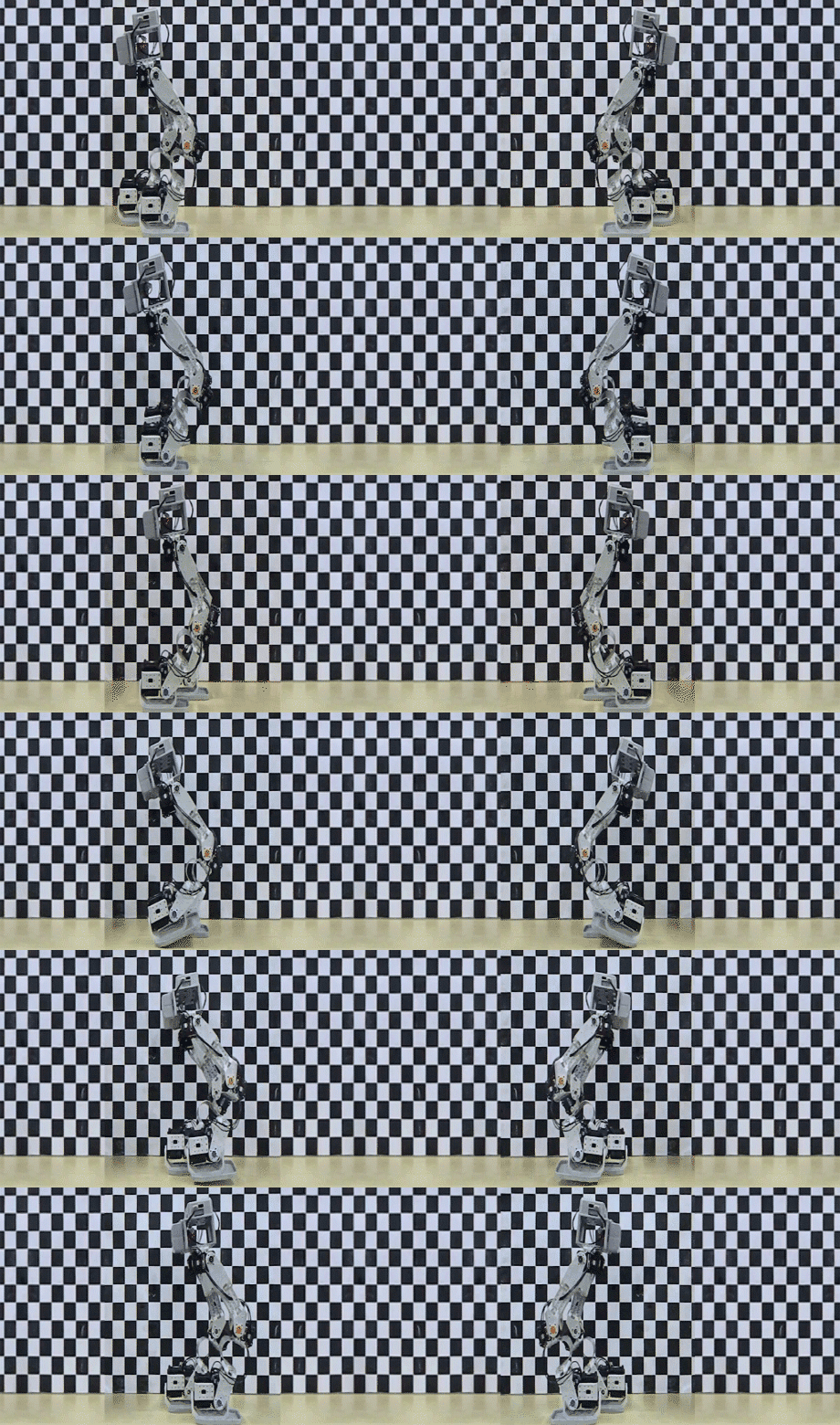
Research Interests: Biped Robot Walking


Akhilendra Pratap Singh
E-mail: This email address is being protected from spambots. You need JavaScript enabled to view it.
Stream: Fluid and Thermal Science
Supervisor: A. K. Agarwal


Ankur Gupta
NL 115 (Northern Laboratories)
0512-2596554

E-mail: This email address is being protected from spambots. You need JavaScript enabled to view it.
Stream: Manufacturing Science
Supervisor: S. Bhattacharya


Research Interests: NANOTECHNOLOGY, BIOMEMS

     
Anshul Faye
E-mail: This email address is being protected from spambots. You need JavaScript enabled to view it.
Stream: Solid Mechanics and Design
Supervisor: S. Basu / P. Venkitanarayanan
Personal homepage:
home.iitk.ac.in/~anshulfy


Research Interests: Experimental solid mechanics, Computational Mechanics, Fracture Mechanics, Dynamic Fracture, Finite element Method


Bisheshwar Choudhury
E-mail: This email address is being protected from spambots. You need JavaScript enabled to view it.
Stream: Manufacturing Science
Supervisor: J. Ramkumar


Dalwai Prashanth Beerapa
E-mail: This email address is being protected from spambots. You need JavaScript enabled to view it.
Stream: Solid Mechanics and Design
Supervisor: N. S. Vyas


Manoj Kumar
E-mail: This email address is being protected from spambots. You need JavaScript enabled to view it.
Stream: Solid Mechanics and Design
Supervisor: P. M. Dixit
 
     
Paritosh Mahata
E-mail: This email address is being protected from spambots. You need JavaScript enabled to view it.
Stream: Solid Mechanics and Design
Supervisor: S. L. Das


Research Interests: Mechanics of Biological Cell Membrane


Patel Chetan Kumar P.
E-mail: This email address is being protected from spambots. You need JavaScript enabled to view it.
Stream: Fluid and Thermal Science
Supervisor: A. K. Agarwal


Ramesh Erelli
E-mail: This email address is being protected from spambots. You need JavaScript enabled to view it.
Stream: Fluid and Thermal Science
Supervisor: A. K. Saha


Research Interests: Heat transfer augmentation, Two-pass channel, Aspect ratio, Nusselt number, IR Thermography.

     
http://www.iitk.ac.in/me/10105145.jpg
Sanjeev Kumar
E-mail: This email address is being protected from spambots. You need JavaScript enabled to view it.
Stream: Fluid and Thermal Science
Supervisor: P. Munshi
Personal homepage: http://home.iitk.ac.in/~sanjeevk/


Research Interests: CFD, Turbulent flow, PWR, Nuclear Reactors simulation, TRIKIN

     
Servesh Kumar Agnihotri
E-mail: This email address is being protected from spambots. You need JavaScript enabled to view it.
Stream: Solid Mechanics and Design
Supervisor: P. Venkitanarayanan


Research Interests: Fracture behavior of transversely graded material

     
Vinay Kumar Patel
E-mail: This email address is being protected from spambots. You need JavaScript enabled to view it.
Stream: Manufacturing Science
Supervisor: S. Bhattacharya
 
     
Abhinav R Dehaai
E-mail: This email address is being protected from spambots. You need JavaScript enabled to view it.
Stream: Solid Mechanics and Design
Supervisor: I. Sharma / S. S. Gupta
 
     
Ashish Agarawal
E-mail: This email address is being protected from spambots. You need JavaScript enabled to view it.
Stream: Fluid and Thermal Science
Supervisor: P. S. Ghoshdastidar


Ayan Roy Chowdhury
E-mail: This email address is being protected from spambots. You need JavaScript enabled to view it.
Stream: Solid Mechanics and Design
Supervisor: A. Gupta


Syed Nadeem Akhtar
E-mail: This email address is being protected from spambots. You need JavaScript enabled to view it.
Stream: Manufacturing Science
Supervisor: J. Ramkumar / S. A. Ramkrishna
 
     
Digenanath Swain
E-mail: This email address is being protected from spambots. You need JavaScript enabled to view it.
Stream: Solid Mechanics and Design
Supervisor: A. Gupta/ Dipankar Das
 
     
Anuj Kumar Trivedi
E-mail: This email address is being protected from spambots. You need JavaScript enabled to view it.
Stream: Nuclear Engg. and Tech. Program
Supervisor:
 
     
Dinkar Verma
E-mail: This email address is being protected from spambots. You need JavaScript enabled to view it.
Stream: Nuclear Engg. and Tech. Program
Supervisor:


Indu Kumari
E-mail: This email address is being protected from spambots. You need JavaScript enabled to view it.
Stream: Nuclear Engg. and Tech. Program
Supervisor:


Babu R.
E-mail: This email address is being protected from spambots. You need JavaScript enabled to view it.
Stream: Fluid and Thermal Science
Supervisor: M. K. Das


Bharti Omprakash Setooram
E-mail: This email address is being protected from spambots. You need JavaScript enabled to view it.
Stream: Fluid and Thermal Science
Supervisor: A. K. Saha / M. K. Das
 
     
Jai Gopal Gupta
E-mail: This email address is being protected from spambots. You need JavaScript enabled to view it.
Stream: Fluid and Thermal Science
Supervisor: A. K. Agarwal


Research Interest: Internal Combustion Engine, Alternative Fuels

     
Prabhat Kumar
E-mail: This email address is being protected from spambots. You need JavaScript enabled to view it.
Stream: Solid Mechanics and Design
Supervisor: A. Saxena
 
     
Vinit Nayar
E-mail: This email address is being protected from spambots. You need JavaScript enabled to view it.
Stream: Solid Mechanics and Design
Supervisor: I. Shama / V. Sharma
 
     
Santanu Das
E-mail: This email address is being protected from spambots. You need JavaScript enabled to view it.
Stream: Solid Mechanics and Design
Supervisor: P. Wahi


Research Interest: Dynamical Systems

     
Satyaprakash Saraswat
E-mail: This email address is being protected from spambots. You need JavaScript enabled to view it.
Stream: Nuclear Engg. and Tech. Program
Supervisor:


B. P. Maddilety
E-mail: This email address is being protected from spambots. You need JavaScript enabled to view it.
Stream: Fluid and Thermal Science
Supervisor: A. K. Saha


Gaurav Saxena
E-mail: This email address is being protected from spambots. You need JavaScript enabled to view it.
Stream: Fluid and Thermal Science
Supervisor: A. K. Saha


Husain Kanchwala
E-mail: This email address is being protected from spambots. You need JavaScript enabled to view it.
Stream: Solid Mechanics and Design
Supervisor: A. Chattergee


Mahesh Kumar
E-mail: This email address is being protected from spambots. You need JavaScript enabled to view it.
Stream: Fluid and Thermal Science
Supervisor: S. Khandekar


Research Interest: Film condensation, containment application, hyogen detonation, hyogen mitigation system


Rajat Dhingra
E-mail: This email address is being protected from spambots. You need JavaScript enabled to view it.
Stream: Fluid and Thermal Science
Supervisor: P. S. Ghoshdastidar


Research Interest: Electronics Cooling, Mixed Convection, Radiation, CFD (FDM, FVM), Turbulent Flow

     
Rajesh Kumar Shukla
E-mail: This email address is being protected from spambots. You need JavaScript enabled to view it.
Stream: Manufacturing Science
Supervisor: Arvind Kumar


Ravi Shankar H
E-mail: This email address is being protected from spambots. You need JavaScript enabled to view it.
Stream: Solid Mechanics and Design
Supervisor: P. Venkitanarayanan


S. Vyas
E-mail: This email address is being protected from spambots. You need JavaScript enabled to view it.
Stream: Fluid and Thermal Science
Supervisor: S. Khandekar
 
     
Sachindananda Behera
E-mail: This email address is being protected from spambots. You need JavaScript enabled to view it.
Stream: Fluid and Thermal Science
Supervisor: A. K. Saha
 
     
Kavita Rathore
E-mail: This email address is being protected from spambots. You need JavaScript enabled to view it.
Stream: Nuclear Engg. and Tech. Program
Supervisor:
 
     
Abdullah Yousuf Usmani
E-mail: This email address is being protected from spambots. You need JavaScript enabled to view it.
Stream: Fluid and Thermal Science
Supervisor: K. Muralidhar


Bal Krishnan Mishra
E-mail: This email address is being protected from spambots. You need JavaScript enabled to view it.
Stream: Fluid and Thermal Science
Supervisor: P. K. Panigrahi

 
Ganesh Babu Shrisath
E-mail: This email address is being protected from spambots. You need JavaScript enabled to view it.
Stream: Fluid and Thermal Science
Supervisor: K. Muralidhar / K. Bala


Mohammad Rashid Zafar Ansari
E-mail: This email address is being protected from spambots. You need JavaScript enabled to view it.
Stream: Solid Mechanics and Design
Supervisor: S. Basu
 

Nirmal halder
E-mail: This email address is being protected from spambots. You need JavaScript enabled to view it.
Stream: Fluid and Thermal Science
Supervisor: Dr. A. K. Saha & Dr. P. K. Panigrahi


Research Interest: Counter rotating vortex pair, DWP, film cooling

     
Saptarshi Mandal
E-mail: This email address is being protected from spambots. You need JavaScript enabled to view it.
Stream: Fluid and Thermal Sciences
Supervisor: P. S. Ghoshdastidar


Research Interest: Nanofluids, Heat transfer, Buongiorno model

     
Saurabh Biswas
E-mail: This email address is being protected from spambots. You need JavaScript enabled to view it.
Stream: Solid Mechanics and Design
Supervisor: Anindya Chattarjee


Research Interest: Reduced order modeling

     
Sayyad Manan Moula
E-mail: This email address is being protected from spambots. You need JavaScript enabled to view it.
Stream: Solid Mechanics and Design
Supervisor: S. Basu / P. Venkitanarayanan
 
     
Somwanshi Praveen Mohanrao
E-mail: This email address is being protected from spambots. You need JavaScript enabled to view it.
Stream: Fluid and Thermal Science
Supervisor: K. Muralidhar / S. Khandekar


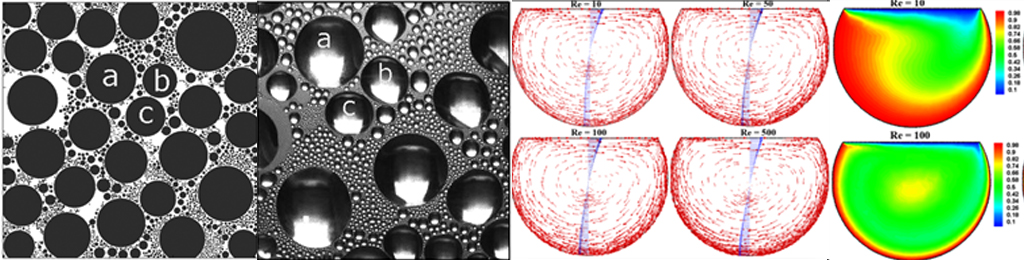
Research Interest: op coalescence, liquid bridge, interfaces,contact lines,contact angles

     
Sonar Prasad Ranganath
E-mail: This email address is being protected from spambots. You need JavaScript enabled to view it.
Stream: Solid Mechanics and Design
Supervisor: I. Sharma
 
     
Archana Gupta
E-mail: This email address is being protected from spambots. You need JavaScript enabled to view it.
Stream: Fluid and Thermal Science
Supervisor: P. K. Panigrahi
 
     
Ashok Kumar
E-mail: This email address is being protected from spambots. You need JavaScript enabled to view it.
Stream: Solid Mechanics and Design
Supervisor: Anindya Chattarjee
 
     
Krishna chanan
E-mail: This email address is being protected from spambots. You need JavaScript enabled to view it.
Stream: Fluid and Thermal Science
Supervisor: K. Muralidhar


Research Interest: Computational Fluid Dynamics

     
Amrita Bhattacharya
E-mail: This email address is being protected from spambots. You need JavaScript enabled to view it.
Stream: Nuclear Engg. and Tech. Program
Supervisor:
 
     
Subhabrata Sarkar
E-mail: This email address is being protected from spambots. You need JavaScript enabled to view it.
Stream: Nuclear Engg. and Tech. Program
Supervisor:
 
     
Anirban Chowdhury
E-mail: This email address is being protected from spambots. You need JavaScript enabled to view it.
Stream: Solid Mechanics and Design
Supervisor: A. Dutta
 
     
Charchit Kumar
E-mail: This email address is being protected from spambots. You need JavaScript enabled to view it.
Stream: Manufacturing Science
Supervisor: Sujeet Kr. Sinha
 
     
Divyansh Patel
E-mail: This email address is being protected from spambots. You need JavaScript enabled to view it.
Stream: Manufacturing Science
Supervisor: V. K. Jain/ J. Ramkumar


Research Interest: Electrochemical micromachining, Surface texturing, Micro-pillars array, Micro-dimples array, Wetting

     
Sateesh Kumar Yadav
E-mail: This email address is being protected from spambots. You need JavaScript enabled to view it.
Stream: Manufacturing Science
Supervisor: Arvind Kumar


Research Interest: Heat Transfer, Solidification, Melting, Heat Storage, Micro Casting

     
Vibhanshu Verma
E-mail: This email address is being protected from spambots. You need JavaScript enabled to view it.
Stream: Fluid and Thermal Science
Supervisor: P. S. Ghoshdastidar
 
     
Amitesh Mishra
E-mail: This email address is being protected from spambots. You need JavaScript enabled to view it.
Stream: Solid Mechanics and Design
Supervisor: Anupam Saxena
 
     
Ashwini Kumar Sengar
E-mail: This email address is being protected from spambots. You need JavaScript enabled to view it.
Stream: Solid Mechanics and Design
Supervisor: P. Wahi / Anindya Chattarjee
 
     
Hemant Sharma
E-mail: This email address is being protected from spambots. You need JavaScript enabled to view it.
Stream: Fluid and Thermal Science
Supervisor: A. K. Agarwal
 
     
Jitena Bhaskar
E-mail: This email address is being protected from spambots. You need JavaScript enabled to view it.
Stream: Solid Mechanics and Design
Supervisor: B. Bhattacharya
 
     
Jitena Kumar
E-mail: This email address is being protected from spambots. You need JavaScript enabled to view it.
Stream: Robotics
Supervisor: A. Dutta
 
     
Jitena Singh
E-mail: This email address is being protected from spambots. You need JavaScript enabled to view it.
Stream: Manufacturing Science
Supervisor: S. Bhattacharya


Research Interest: BioMEMS

     
Rahul yadav
E-mail: This email address is being protected from spambots. You need JavaScript enabled to view it.
Stream: Fluid and Thermal Science
Supervisor: S. Khandekar
 
     
Ramkrishna Sha
E-mail: This email address is being protected from spambots. You need JavaScript enabled to view it.
Stream: Fluid and Thermal Science
Supervisor: S. Khandekar
 
     
Sahil Kalra
E-mail: This email address is being protected from spambots. You need JavaScript enabled to view it.
Stream: Solid Mechanics and Design
Supervisor: B. Bhattacharya
 
     
Abhilasha Singh
E-mail: This email address is being protected from spambots. You need JavaScript enabled to view it.
Stream:
Supervisor:
 
     
Ajay Bhandari
E-mail: This email address is being protected from spambots. You need JavaScript enabled to view it.
Stream:
Supervisor:
 
     
Akkarapakam Sunesh Jacob
E-mail: This email address is being protected from spambots. You need JavaScript enabled to view it.
Stream:
Supervisor:
 
     
Amit Kumar Rai
E-mail: This email address is being protected from spambots. You need JavaScript enabled to view it.
Stream:
Supervisor:
 
     
Arindam Chakraborty
E-mail: This email address is being protected from spambots. You need JavaScript enabled to view it.
Stream:
Supervisor:
 
     
Ashish Tewari
E-mail: This email address is being protected from spambots. You need JavaScript enabled to view it.
Stream:
Supervisor:
 
Atindar Pal Singh
E-mail: This email address is being protected from spambots. You need JavaScript enabled to view it.
Stream:
Supervisor:


Bibeka Nanda Padhi
E-mail: This email address is being protected from spambots. You need JavaScript enabled to view it.
Stream:
Supervisor:
 
Deepak Sachan
E-mail: This email address is being protected from spambots. You need JavaScript enabled to view it.
Stream:
Supervisor:
 

Digvijay Singh
E-mail: This email address is being protected from spambots. You need JavaScript enabled to view it.
Stream:
Supervisor:


Gaganpreet Singh
E-mail: This email address is being protected from spambots. You need JavaScript enabled to view it.
Stream:
Supervisor:

 
Geeta Bhatt
E-mail: This email address is being protected from spambots. You need JavaScript enabled to view it.
Stream:
Supervisor:
 
Harshit Kumar Gupta
E-mail: This email address is being protected from spambots. You need JavaScript enabled to view it.
Stream:
Supervisor:
 
Kartikeya Dixit
E-mail: This email address is being protected from spambots. You need JavaScript enabled to view it.
Stream:
Supervisor:
 
Maneesh Punetha
E-mail: This email address is being protected from spambots. You need JavaScript enabled to view it.
Stream:
Supervisor:
 

Manmeet Singh
E-mail: This email address is being protected from spambots. You need JavaScript enabled to view it.
Stream:
Supervisor:


Poonam Sundariyal
E-mail: This email address is being protected from spambots. You need JavaScript enabled to view it.
Stream:
Supervisor:
 
     
Sanjeev Kumar Ghai
E-mail: This email address is being protected from spambots. You need JavaScript enabled to view it.
Stream: Fluid and Thermal Sciences
Supervisor: Santanu De
 
     
Shree Ram Pandey
E-mail: This email address is being protected from spambots. You need JavaScript enabled to view it.
Stream:
Supervisor:
 
     
Shruti Pandey
E-mail: This email address is being protected from spambots. You need JavaScript enabled to view it.
Stream:
Supervisor:
 
     
Supriya Upadhyay
E-mail: This email address is being protected from spambots. You need JavaScript enabled to view it.
Stream:
Supervisor:
 
     
Sushil Patel
E-mail: This email address is being protected from spambots. You need JavaScript enabled to view it.
Stream:
Supervisor:
 
     
Vikram Soni
E-mail: This email address is being protected from spambots. You need JavaScript enabled to view it.
Stream:
Supervisor:
 
Kartar Singh
NL 115 (Northern Laboratories)
0512-2597149(O)
E-mail: This email address is being protected from spambots. You need JavaScript enabled to view it.
Stream: Manufacturing Science
Supervisor: J. Ramkumar


Research Interest: Laser Micromachining

Anjali Dwivedi
E-mail: This email address is being protected from spambots. You need JavaScript enabled to view it.
Stream: Fluid and Thermal Sciences
Supervisor: Subrata Sarkar


Research Interest: Experimental and simulation work

Ashish Tiwari
Email: This email address is being protected from spambots. You need JavaScript enabled to view it.
Stream: Manufacturing Science
Supervisor: Niraj Sinha
Personal homepage:
http://home.iitk.ac.in/~ashisagl/


Research Interest: Biomechanics, Material Selection,

Ashish Agrawal
FB 354 (Faculty Building)
0512-2597218(O)
E-mail: This email address is being protected from spambots. You need JavaScript enabled to view it.
Stream: Fluid and Thermal Sciences
Supervisor: P.S. Ghoshdas
Personal homepage: http://home.iitk.ac.in/~ashisagl/


Research Interest: Computational Heat Transfer & Fluid Dynamics, Rotary Kiln Modelling, Electronics Cooling

Prem Kumar
SL109 (Southern Laboratories)
0512-2597218(O)
E-mail: This email address is being protected from spambots. You need JavaScript enabled to view it.
Stream: Fluid and Thermal Sciences
Supervisor: Sameer Khandekar
Personal homepage: http://home.iitk.ac.in/~ashisagl/


Research Interest: Loop Heat Pipe

Abhay kumar
E-mail: This email address is being protected from spambots. You need JavaScript enabled to view it.
Stream: Fluid and Thermal Sciences
Supervisor: Prof. P. K. Panigrahi & Dr. A. K. Saha


Research Interest: Synthetic jet, Autonomous Underwater Vehicle, Vortex dynamics, Flow visualization and velocity measurement

Shyam Prasad Kodali
NL 214 (Northern Laboratories)
0512-2597237
E-mail: This email address is being protected from spambots. You need JavaScript enabled to view it.
Stream: Solid Mechanics and Design
Supervisor: Dr. N. N. Kishore, Dr. P. Munshi


Research Interest: Non Destructive Evaluation, Ultrasound Tomography, Genetic Algorithms, Composites, Ray Tracing

Guruprasad T.
NL 211 (Northern Laboratories)
0512-2596034
E-mail: This email address is being protected from spambots. You need JavaScript enabled to view it.
Stream: Solid Mechanics and Design
Supervisor: Dr. Sumit Basu, Dr. Shantanu Bhattacharya


Research Interest: Mechanical Characterization, Size Effects, In-Situ Testing, FEM

Omprakash Bharti
Energy Storage Lab
0512-2596530
E-mail: This email address is being protected from spambots. You need JavaScript enabled to view it.
Stream: Fluid and Thermal Sciences
Supervisor: Dr. A. K. Saha & Dr. M. K. Das


Research Interest: Flow visualization, schlieren technique, temperature measurement, stereoscopic schlieren system

Vijay Kumar Pal
NL 115 (Northern Laboratories)
E-mail: This email address is being protected from spambots. You need JavaScript enabled to view it.
Stream: Manufacturing Science
Supervisor: S.K.Choudhary


Research Interest: AWJM,Optimization, Machining,texturing

Tapan Kumar Pradhan
E-mail: This email address is being protected from spambots. You need JavaScript enabled to view it.
Stream: Fluid and Thermal Sciences
Supervisor: P. K. Panigrahi
Personal homepage:
home.iitk.ac.in/~tapankp


Research Interest: Microfluidics, oplet, Rayleigh Convection, Marangoni Convection

Vineet Nair
FB 339 (Faculty Building)
0512-2596166
E-mail: This email address is being protected from spambots. You need JavaScript enabled to view it.
Stream: Solid Mechanics and Design
Supervisor: Ishan Sharma, Viswanathan Shankar


Research Interest: fluid-structure interactions, mechanics of granular media, mechanics of crystalline materials

Raghvena Pratap Singh
NL302 (Northern Laboratories)
0512-2597429
E-mail: This email address is being protected from spambots. You need JavaScript enabled to view it.
Stream: Fluid and Thermal Sciences
Supervisor: K Muralidha and M K Das


Research Interest: Porous Media, Gas Hyate , Hyate Reservoir, Multiphase Flows, Diffusion

Puneet Jindal
E-mail: This email address is being protected from spambots. You need JavaScript enabled to view it.
Stream: Manufacturing Science
Supervisor: Jishnu Bhattacharya


Research Interest: Thermal management of Batteries in Hybrid Electric vehicles

Nikhil Sharma
Engine Research Laboratory
E-mail: This email address is being protected from spambots. You need JavaScript enabled to view it.
Stream: Fluid and Thermal Sciences
Supervisor: A.k.Agarwal
Personal homepage: http://www.iitk.ac.in/erl/People%20
Current%20PhD%20Nikhil.htm


Research Interest: IC Engine (GDI Engine)

Prasad Ranganath Sonar
FB 339 (Faculty Building)
0512-2596166
E-mail: This email address is being protected from spambots. You need JavaScript enabled to view it.
Stream: Solid Mechanics and Design
Supervisor: Ishan Sharma and J. K Singh


Research Interest: Granular Materials

Arun Kumar Sharma
NL 102 (Northern Laboratories)
0512-2597913
E-mail: This email address is being protected from spambots. You need JavaScript enabled to view it.
Stream: Solid Mechanics and Design
Supervisor: Bishakh Bhattacharya


Research Interest: Structural health monitoring,Vibration,Smart materials and Non-destructive testing

Menaka Attmaja Ray
NL 311 (Northern Laboratories)
0512-2597429
E-mail: This email address is being protected from spambots. You need JavaScript enabled to view it.
Stream: Fluid and Thermal Sciences
Supervisor: Malay Kumar Das


Research Interest: Photoelectrochemical Device simulation

Siva Prasad AVS
NL 211 (Northern Laboratories)
0512-2596034
E-mail: This email address is being protected from spambots. You need JavaScript enabled to view it.
Stream: Solid Mechanics and Design
Supervisor: Sumit Basu
Personal Homepage: https://sites.google.com/site/sivaprasadavs/


Research Interest: High strain rate phenomena and shock waves in solids, Smoothed Particle Hyodynamics (SPH).

Rupal Srivastava
E-mail: This email address is being protected from spambots. You need JavaScript enabled to view it.
Stream: Solid Mechanics and Design
Supervisor: Bishakh Bhattacharya


Research Interest: Vibrations

Jitendra K. Katiyar
NL 206 (Northern Laboratories)
0512-2596757
E-mail: This email address is being protected from spambots. You need JavaScript enabled to view it.
Stream: Manufacturing Science
Supervisor: Dr. Arvind Kumar and Dr. Sujeet K. Sinha


Research Interest: Tribology

Anand Prakash Dwivedi
NL 115 (Northern Laboratories)
0512-2597149
E-mail: This email address is being protected from spambots. You need JavaScript enabled to view it.
Stream: Manufacturing Science
Supervisor: S. K. Choudhury


Research Interest: EDM, Modeling, Optimization, Surface Analysis

Rekha Raja
Mechatronics Lab (Northern Laboratories)
E-mail: This email address is being protected from spambots. You need JavaScript enabled to view it.
Stream: Robotics and Mechatronics
Supervisor: Ashish Dutta, Bhaskar Dasgupta


Research Interest: Mobile manipulator, Motion planning, Image processing, Machine Learning

Arpit Kumar Srivastava
NL 211 (Northern Laboratories)
E-mail: This email address is being protected from spambots. You need JavaScript enabled to view it.
Stream: Solid Mechanics and Design
Supervisor: Sumit Basu
Personal Homepage:
http://arpit-srivastava.branded.me/?fb_ref=Default


Research Interest: Mechanics of dielectric elastomers

Raghubeer Singh Bangari
0512-2596809(O)
E-mail: This email address is being protected from spambots. You need JavaScript enabled to view it.
Stream: Manufacturing Science
Supervisor: Dr. Niraj Sinha


Research Interest: water treatment, Heavy metals, sensors.

Amarjit Prakashrao Kene
NL 105 (Northern Laboratories Extension)
0512-2597149(O)
E-mail: This email address is being protected from spambots. You need JavaScript enabled to view it.
Stream: Manufacturing Science
Supervisor: S. K. Choudhury


Research Interest: Conventional Machining, Online Condition Monitoring, Rapid Prototyping,

Sanjay Kumar
Micro fabrication Lab
E-mail: This email address is being protected from spambots. You need JavaScript enabled to view it.
Stream: Manufacturing Science
Supervisor: Shantanu Bhattacharya
Personal Homepage:
https://sites.google.com/site/krsanjayme/


Research Interest: BIO MEMS, DNA Replication, ug delivery system

Ganesh Shirsath
Micro fabrication Lab

E-mail: This email address is being protected from spambots. You need JavaScript enabled to view it.
Stream: Fluid and Thermal Sciences
Supervisor: K. Muralidhar


Research Interest: Solar Energy, Membrane Distillation

Sunit Kumar Gupta
Micro fabrication Lab

E-mail: This email address is being protected from spambots. You need JavaScript enabled to view it.
Stream: Solid Mechanics and Design
Supervisor: Pankaj Wahi


Research Interest: Nonlinear dynamics, Drilling, Nonlocal elasticity

Ankush Punamchand Sharma
NL 216 (Northern Laboratories)
0512-2597509
Micro fabrication Lab
E-mail: This email address is being protected from spambots. You need JavaScript enabled to view it.
Stream: Solid Mechanics and Design
Supervisor: P. Venkitanarayanan


Research Interest: Digital image correlation, Classical lamination theory, Fiber metal

Rajesh Kumar Prasad
Engine Research Laboratory
0512-2597458
Micro fabrication Lab

E-mail: This email address is being protected from spambots. You need JavaScript enabled to view it.
Stream: Fluid and Thermal Sciences
Supervisor: A. K. Agarwal


Research Interest: Laser Ignited Internal Combustion Engine

Sreejith V. S.
Dhwani Lab (Northern Laboratories)
0512-2596986
E-mail: This email address is being protected from spambots. You need JavaScript enabled to view it.
Stream: Solid Mechanics and Design
Supervisor: Nachiketa Tiwari
Personal Homepage:

http://home.iitk.ac.in/~vssree/


Research Interest: Under-water acoustics

Dev Prakash Satsangi
Dhwani Lab (Northern Laboratories)
0512-2596986
E-mail: This email address is being protected from spambots. You need JavaScript enabled to view it.
Stream: Solid Mechanics and Design
Supervisor: Nachiketa Tiwari


Research Interest: Underwater Acoustics, Composites

Gaurav Maurya
NL 1 (Nonlinear Mechanics Lab)
E-mail: This email address is being protected from spambots. You need JavaScript enabled to view it.
Stream: Solid Mechanics and Design
Supervisor: Shakti S. Gupta and Jayant K. Singh


Research Interest: Wave propagation, CNTs, HCCNTs, etc.

Sanan H. Khan
NL 216 (Northern Laboratories)
0512-2597507
E-mail: This email address is being protected from spambots. You need JavaScript enabled to view it.
Stream: Solid Mechanics and Design
Supervisor: P. Venkitanarayana


Research Interest: Composite damage analysis, High speed testing, Digital image correlation,

Sachidananada Behera
SL 210 (Southern Laboratories)
E-mail: This email address is being protected from spambots. You need JavaScript enabled to view it.
Stream: Fluid and Thermal Sciences
Supervisor: ARUN K. SAHA
Personal Homepage:
http://home.iitk.ac.in/~sateeshk/


Research Interest: CFD, Turbulence, JICF, Flow past Bluff bodies

Kashfull Orra
NL 115 (Northern Laboratories)
0512-2597149
E-mail: This email address is being protected from spambots. You need JavaScript enabled to view it.
Stream: Manufacturing Science
Supervisor: ARUN K. SAHA


Research Interest: Adoptive Control System, Mathematical Modeling, Simulation, Hard Turning, DOE, Optimization, Machining

Beteley Teka Hailu
NL 312 (Northern Laboratories)
0512-2597995
E-mail: This email address is being protected from spambots. You need JavaScript enabled to view it.
Stream: Robotics and Mechatronics
Supervisor: Dr. Ashish Dutta


Research Interest: Mobile robotics, Lunar Rover

Leeladhar Nagdeve
NL 115 (Northern Laboratories)
0512-2597149
E-mail: This email address is being protected from spambots. You need JavaScript enabled to view it.
Stream: Manufacturing Science
Supervisor: J. Ramkumar, V. K. Jain
Personal Homepage:
http://home.iitk.ac.in/~liladhar


Research Interest: Nano-finishing of freeform/sculptured surfaces

Vikram Kumar
E-mail: This email address is being protected from spambots. You need JavaScript enabled to view it.
Stream: Fluid and Thermal Sciences
Supervisor: Avinash Kumar Agarwal and Sujeet Kumar Sinha


Research Interest: Green Tribology, Soft and Hard Dual Coating, Lubrication, Friction and Wear

Krishnan S.
NL 1 (Nonlinear Mechanics Lab)
0512-2597149
E-mail: This email address is being protected from spambots. You need JavaScript enabled to view it.
Stream: Solid Mechanics and Design
Supervisor: Sovan Lal Das, Ishan Sharma


Research Interest: Contact mechanics, Adhesion, Solid mechanics

Rajesh Kumar Yadav
NL 1 (Nonlinear Mechanics Lab)
E-mail: This email address is being protected from spambots. You need JavaScript enabled to view it.
Stream: Solid Mechanics and Design
Supervisor: Shakti S. Gupta


Research Interest: Non Local Continuum Theories

Arun Agrawal
NL 213 (Northern Laboratories)
0512-2596087
E-mail: This email address is being protected from spambots. You need JavaScript enabled to view it.
Stream: Solid Mechanics and Design
Supervisor: P. Venkitanarayanan and N. N. Kishore


Research Interest: advanced materials + fracture mechanics

Pradeep Singh
E-mail: This email address is being protected from spambots. You need JavaScript enabled to view it.
Stream: Fluid and Thermal Sciences
Supervisor: Subrata Sarkar


Research Interest: Heat Transfer, Turbomachinery

Rishi Kant
0512-2596554
E-mail: This email address is being protected from spambots. You need JavaScript enabled to view it.
Stream: Manufacturing Science
Supervisor: Shantanu Bhattacharya


Research Interest: Bio-MEMS, Microfluidics, Micro manufacturing, sensor and actuator, Modeling of Bio-microdevices.

Anish Kumar
NL 1 (Nonlinear Mechanics Lab)
E-mail: This email address is being protected from spambots. You need JavaScript enabled to view it.
Stream: Solid Mechanics and Design
Supervisor: Pankaj Wahi and Sovan Das


Research Interest: Dynamics of Shells

Mannan M. Sayyad
NL 211 (Northern Laboratories)
0512-2596034
E-mail: This email address is being protected from spambots. You need JavaScript enabled to view it.
Stream: Solid Mechanics and Design
Supervisor: Pankaj Wahi and Sovan Das


Research Interest: Dynamics of Shells, Multiscale modelling of natural material- bamboo

Mayank Chouksey
NL 211 (Northern Laboratories)
E-mail: This email address is being protected from spambots. You need JavaScript enabled to view it.
Stream: Solid Mechanics and Design
Supervisor: Sumit Basu


Research Interest: Fracture Mechanics, FEM

Laxminarsimha Rao Vennamneni
NL 1 (Nonlinear Mechanics Lab)
E-mail: This email address is being protected from spambots. You need JavaScript enabled to view it.
Stream: Solid Mechanics
Supervisor: Sovan Lal Das


Research Interest: Motion and interaction of domains in lipid bilayer membranes, Periodic orbits around elliptical bodies, Contact mechanics

Vaibhav Dhar Dwivedi
NL 1 (Nonlinear Mechanics Lab)
E-mail: This email address is being protected from spambots. You need JavaScript enabled to view it.
Stream: Solid Mechanics
Supervisor: Dr. N. S. Vyas


Research Interest: Vibration, Vehicle Dynamics, Structural Health Monitoring,

Kapil Manoharan
NL 1 (Nonlinear Mechanics Lab)
E-mail: This email address is being protected from spambots. You need JavaScript enabled to view it.
Stream: Manufacturing Science
Supervisor: Shantanu Bhattacharya


Research Interest: Mems, Microfluidics, Micro-nano engineering

Pawan Kumar Pandey
NL 311 (Northern Laboratories)
E-mail: This email address is being protected from spambots. You need JavaScript enabled to view it.
Stream: Fluid and Thermal Sciences
Supervisor: Malay K. Das


Research Interest: Biofluid Mechanics

Ravi Sankar H.
NL 216 (Northern Laboratories)
0512-2597507
E-mail: This email address is being protected from spambots. You need JavaScript enabled to view it.
Stream: Solid Mechanics and Design
Supervisor: P Venkitanarayanan


Research Interest: Dynamic impact, dynamic buckling

Arindam Bhattacharjee
FB 362 (Faculty Building)
E-mail: This email address is being protected from spambots. You need JavaScript enabled to view it.
Stream: Solid Mechanics and Design
Supervisor: Anindya Chatterjee


Research Interest: Nonlinear dynamics

Venugopala Swami Punati
FB 339 (Faculty Building)
E-mail: This email address is being protected from spambots. You need JavaScript enabled to view it.
Stream: Solid Mechanics and Design
Supervisor: Ishan Sharma and Pankaj Wah


Research Interest: Contact mechanics

Dileep V. Nair
E-mail: This email address is being protected from spambots. You need JavaScript enabled to view it.
Stream: Fluid and Thermal Sciences
Supervisor: P. S. Ghoshdastidar


Research Interest: Natural Convection, Synthetic Jets, Numerical Simulation

Rahul Oorath
Dhwani Lab (Northern Laboratories)
0512-2596986
E-mail: This email address is being protected from spambots. You need JavaScript enabled to view it.
Stream: Solid Mechanics and Design
Supervisor: Dr. Nachiketa Tiwari
Personal Homepage:
http://home.iitk.ac.in/~rahulo/index.html


Research Interest: Acoustics, Underwater Acoustics, Non Linear Vibration, Vibration Control

Jithin M.
NL 311 (Northern Laboratories)
0512-2597429
E-mail: This email address is being protected from spambots. You need JavaScript enabled to view it.
Stream: Solid Mechanics and Design
Supervisor: Malay K. Das


Research Interest: Lattice Boltzmann Method

Pankaj Singh Chauhan
E-mail: This email address is being protected from spambots. You need JavaScript enabled to view it.
Stream: Manufacturing Science
Supervisor: Shantanu Bhattacharya, Niraj Sinha


Research Interest: Manufacturing of micro scale bio-engineering devices, micro-manufacturing, Microfluidics

Ashwani Kumar Sengar
NL 1 (Nonlinear Mechanics Lab)
E-mail: This email address is being protected from spambots. You need JavaScript enabled to view it.
Stream: Solid Mechanics and Design
Supervisor: Pankaj Wahi/ Anindya Chatterjee


Research Interest: Thermoacoustic instabilities

Narendra Gajbhiye
E-mail: This email address is being protected from spambots. You need JavaScript enabled to view it.
Stream: Fluid and Thermal Sciences
Supervisor: Vinayak Eswaran & Prof. K. Muralidhar


Research Interest: MHD Flows, CFD, ESP


Undergraduate-level Courses

Compulsory Courses

Syllabus:

History of engineering materials, Engineering materials, Materials property chart, Crystal structure, Imperfections of solids, Mechanism of strengthening in metals, Hall-Petch effect, X-ray diffraction, Fracture: Ductile, brittle, fatigue. Griffith criterion, S-N curve, Creep, Phase diagram (binary), Iron-carbon system, Heat treatment of metals, Electrical properties, Thermal properties, Magnetic properties, Optical properties, Corrosion, Oxidation, Thermal stability , Wear, abrasion, friction of materials, Characterization techniques: Optical microscopy, scanning electron microscopy, transmission electron microscopy, atomic force microscopy, Polymer and its characterization, Viscoelasticity, Nanomaterials and its important properties at nanoscale, Composites: Characterization of composites, Ionic polymer matrix composites, Shape memory alloy, Intelligent Multifunctional materials, Economics, Environment, and Sustainability. Click here for more information..

Credits:

7

Prerequisites:

None

Syllabus:

Reynolds Transport Theorem; Integral form of continuity, momentum and energy equations; Eulerian and Lagrangian view-points; Constitutive relations; Navier Stokes equations; Exact solutions; Potential flow; Boundary layer theory; Separation and drag; Turbulent flow: Reynolds averaged equations; Turbulent flows in pipes and channels; compressible flows. Click here for more information..

Credits:

10

Syllabus:

Theory of general engineering design, conceptual design, embodiment design, designing to standard, basic sketching, machine drawing, dimensioning as per standards, fits and tolerances, machine elements, assembly drawing, geometrical modeling, and use of CAD software for modeling and animation. Click here for more information..

Credits:

5

Prerequisites:

TA 201, TA 202

Syllabus:

Introduction to energy resources and conversion systems: Fossil fuels, Nuclear energy, Hydrogen, Renewable energy sources. Thermal energy to Mechanical Energy Conversion: Internal Combustion Engine Technology, Real Cycles, Combustion, Emissions, Performance and Testing. Mechanical Energy to Thermal Energy Conversion: Modern Refrigeration and Air-conditioning Systems. Click here for more information..

Prerequisites:

None

Syllabus:

Introduction to Cartesian tensors; Strains: Concept of strain, derivation of small strain tensor and compatibility; Stress: Derivation of Cauchy relations and, equilibrium and symmetry equations, principal stresses and directions; Constitutive equations: Generalized Hooke’s law including thermoelasticity, Material symmetry; Boundary Value Problems: Definition of the bvp in linear elasticity including concepts of uniqueness and superposition; 2-d plane stress and plane strain problems, introduction to governing equations in cylindrical and spherical coordinates, axisymmetric problems (examples may include problems on curved beams, thermoelasticity, torsion of non-circular cross sections, contact problems in 2-d, problems on wedges and crack tip fields); 3-d problems by potential methods; Energy methods and problems. Click here for more information..

Credits:

7

Prerequisites:

ESO 204

Syllabus:

Introduction. One-dimensional and Two-dimensional Steady and Transient Conduction. Forced Convection over a flat plate and inside tubes. Natural Convection over a vertical flat plate. Mass Transfer. Boiling and Condensation. Heat Exchangers. Thermal Radiation. Heat Transfer Applications. Click here for more information..

Credits:

9

Prerequisites:

ME 231

Syllabus:

Introduction to design of systems and machine elements; Modes of failure, strength, stiffness and stability; Failure theories; Fatigue failure; Probabilistic approach to design; Design of Bolted and Welded joints, Helical compression springs and leaf springs, Spur and Helical gear sets; Selection of Rolling contact bearings; Design of shafts. Lab sessions: Detailed design of the above machine elements starting functional specifications to final sizing; Design of a subsystem involving multiple machine elements. Introduction to use of techniques like FEM for design. Click here for more information..

Prerequisites:

ME 231

Syllabus:

Kinematic pairs, diagrams and inversion. Mobility and range of movement. Displacement, velocity and acceleration analysis of planar linkages. Dimensional synthesis for motion, path and function generation. Dynamic force analysis, flywheels. Inertia forces and balancing for rotating and reciprocating machines. Cam mechanisms, Cam profile synthesis. Gears and gear trains. Click here for more information..

Credits:

7

Prerequisites:

ESO 209

Syllabus:

Introduction to modeling of dynamical systems. Single Degree of Freedom Systems – Free undamped vibration, Free damped vibration, Forced vibration, Transmissibility, Convolution method, Mechanisms of damping. Two Degree of Freedom System (undamped vibration only) – Free and forced vibrations, vibration absorber. Multi Degree of Freedom Systems (undamped and proportional damping) – Matrix methods, Modal analysis. Approximate Methods. Vibration of continuous systems (free vibration only). Introduction to controls. Review of Laplace transforms. Block diagrams. Root locus method. Stability – Routh-Hurwith criterion, Nyquist plots. Bode plots. Controller performance and types. Steady state errors and constants. Types of feedback control systems – Derivative error compensation, Integral error compensation, Proportional error compensation. Modern control. Digital control. Click here for more information..

Prerequisites:

ESO 209

Syllabus:

Introduction to manufacturing processes and system concept and its evolution; Metal casting: Solidification Mechanism, Gating and Riser Design, Defects and Product Design; Metal Forming: Fundamentals of Plasticity, Force Equilibrium Method, Forging/upsetting, Drawing, Extrusion, Deep Drawing and Bending, Defects; Machining: Tool Specifications, Orthogonal and Oblique cutting, Tool wear and Tool Life, Economics of Machining; Shaping processes for Plastics and Tool Design; Joining Processes; Un-Conventional Material Removal Processes: ECM, EDM, LBM and Jet Machining; Rapid Prototyping and Tooling; Micro-fabrication technologies; Metrology and Selection of Manufacturing Processes. Click here for more information..

Credits:

8

Credits:

10

Prerequisites:

ESO 209

Syllabus:

Introduction: General Theory and Classification of Turbomachines; Similarity and Dimensional Analysis; Two-dimensional Cascade Theory; Axial and Radial Flow Machines: Turbines, Compressors and Fans; Gas Turbine Power Plant Cycles; Thermal Power plant: Flow through Nozzle and Steam Turbines; Hydraulic Machines: Pelton, Francis and Kaplan Turbines; Pump and Cavitation. Click here for more information..

Credits:

10

Syllabus:

Introduction to manufacturing, Manufacturing system concept. Manufacturing automation, FMS, CIMS, Flow lines and assembly systems, Automated storage / retrieval systems, AGV. Introduction to CAD/CAM, NC, CNC, DNC, Adaptive control. Manual and computer assisted part programming. Introduction to robots and their application in manufacturing. Process planning and Computer Aide Process planning. Group Technology, Opitz System and GT benefits. Material Management and Inventory control, MRP and MRP II. Just in time (JIT) and Lean manufacturing. Introduction to quality assurance and control, Statistical Quality Control, control charts, sampling. Total Quality Management. Manufacturing system simulation. Click here for more information..

Credits:

9

Credits:

6

Prerequisites:

ME231, ME 341, ME 351, ME361

Syllabus:

More details.Click here for more information..

Elective Courses

Syllabus:

Thermodynamics and heat transfer, Refrigeration/Heat Pump Cycles, Elements of a vapor compression refrigeration system, Types, Design calculations, Refrigerants and their impact on the environment, Thermodynamics of moist air, Psychrometry, Load calculations, Solar radiation and interaction with building structures, Introduction to some non-conventional refrigeration systems, Industrial Applications/ Case studies/ Field visits/ Project. Click here for more information..

Credits:

09

Credits:


Prerequisites:

ESO 201

Syllabus:

Introduction to Internal Combustion Engines, Basic Introduction to SI & CI engine, Air Standard Cycles and their Analysis, Fuel-Air Cycles and their analysis, Conventional fuels & Alternative fuels, Fossil fuels: Refining & Properties, Analysis of fossil fuels, Fundamentals of SI & CI engine, Engine Ignition System, Engine cooling system, Engine Friction and Lubrication, Supercharging and Turbocharging, Carburetor and Fuel Injection Systems, Fuel Injection in SI engine, Combustion in CI Engines, Knocking in SI and CI engine, Combustion Chamber Design of SI and CI engines, Wankel Engine, Engine Performance parameters, Measurement and Testing, Pollution from SI and CI engines, Emission Measurement Instruments, gasoline Direct Injection Engine (if time permits), Homogeneous charge compression ignition (HCCI) Engine.Click here for more information..

Syllabus:

Introduction: Refrigeration and air-conditioning, definitions, Psychrometry, sensible/ latent cooling loads, apparatus, dew point, complete psychrometric analysis, building heat load calculation, infiltration and moisture transport, winter air conditioning, part load operations and control; Refrigeration cycles, multi-staging and cascading, aircraft refrigeration and air conditioning, design of cooling coil, heat pump, solar refrigeration system; Supporting material: Boiling heat transfer, forced convection boiling, film condensation, condensation on radial systems, Overall heat transfer coefficient, LMTD and NTU methods, cooling tower; Special topics/case studies: such as Solar thermal dynamics, Click here for more information..

Credits:


Credits:


Prerequisites:


Syllabus:

The equations of motion in rotating coordinate system, effect of Coriolis and Centrifugal forces, energy equation; classification of turbomachines; two-dimensional cascade theory; fundamentals, two-dimensional analysis, angular momentum & energy transfer, h-s diagram, degree of reaction, effect of Mach number, performance and efficiency; three-dimensional flow in axial turbomachines, radial equilibrium, secondary flow, tip clearance and loss estimation; radial and mixed flow machines; multistage axial compressors and turbines; prediction of stage performance and Click here for more information..

Credits:


Credits:


Prerequisites:


Syllabus:

The purpose of the course is to expose the students to the basic elements of continuum mechanics in a sufficiently rigorous manner. After attending this course, the students should be able to appreciate a wide variety of advanced courses in solid and fluid mechanics Click here for more information..

Credits:


Credits:


Prerequisites:


Syllabus:

History of calculus of variations: Discussion of certain classical and modern problems in mechanics that led the emergence and development of calculus of variations. Contributions of Bernoulli(s), Euler, Lagrange, Jacobi, Weierstrass, Hamilton, Legendre and some others will be discussed briefly; Definition of a function, function space (with examples of function spaces that are important in engineering and sciences) and so called 'functional'; Definition of the first variation of a functional and a variational derivative. Necessary condition for an extremum. Euler equation. Discussion on Null Lagrangian and natural boundary condition. Constraints and Lagrange multipliers Click here for more information..

Credits:


Credits:


Prerequisites:


Syllabus:

This course aims to setting-up initial-boundary value problems for some important and fundamental structural members viz. bars, strings, membrane and plates. Analytical and approximate solutions to these problems for various loading and boundary conditions are discussed and analyzed. Click here for more information..

Credits:


Credits:


Prerequisites:


Syllabus:

This course will introduce the students to the basics of nonlinear dynamics with a specific emphasis on second order systems representing vibration problems. Computer based assignments and tests will be used to complement the in-class evaluations. Use of symbolic algebra packages and computations using MATLAB will be encouraged.. Click here for more information..

Credits:


Credits:


Prerequisites:


Syllabus:

Introduction: Governing equations for fluid flow and heat transfer, classifications of PDE, finite difference formulation, various aspects of finite difference equation, error and stability analysis, dissipation and dispersion errors, modified equations; Solutions of simultaneous equations: iterative and direct methods, TDMA, ADI; Elliptic PDE: One- and Twodimensional steady heat conduction and their solutions, extension to three-dimensional; Click here for more information..

Credits:


Credits:


Prerequisites:


Syllabus:

Equations of motion in rotating coordinate frames, Cartesian approximations, Density stratified flows and internal gravity waves, Taylor-Proudman theorem, Ekman layer, single and multiple layered shallow-water systems, Geostrophic adjustment and Thermal-wind balance, Potential vorticity, Poincare, Kelvin and Rossby waves, Kelvin-Helmholtz instability, Baroclinic instability, Wave-mean theory, 2D turbulence, Click here for more information..

Credits:


Credits:


Prerequisites:


Syllabus:

The primary objective of the course is to teach fundamentals of computational method for solving non-linear partial differential equations (PDE) primarily in complex geometry. The emphasis of the course is to teach CFD techniques for solving incompressible and compressible N-S equation in primitive variables, Click here for more information..

Credits:


Credits:


Prerequisites:


Syllabus:

Phase-change Thermo-physics, Equations of state, Phase diagrams, Phasestability and spinoidals, Interfacial tension, Free energy, Wetting and hysteresis. Click here for more information..

Credits:


Credits:


Prerequisites:


Syllabus:

Introduction, review of thermodynamics, adiabatic flame temperature, chemical equilibrium, chemical kinetics, steady-state approximation, partial equilibrium, mass transfer, conservation equations and transport properties, laminar premixed flame, flame speed, ignition, quenching, flammability limits and stability, laminar non-premixed flame, conserved scalar concept, estimation of flame height, burning rate for a single droplet, Click here for more information..

Credits:


Credits:


Prerequisites:


Syllabus:

The primary objective of the course is to teach fundamentals of turbulent flows, an important topic in fluid dynamics. The course coverage includes: Statistical representation of turbulent flows, energy cascade, Kolmogorov hypothesis, free shear and wall-bounded flows apart from introduction to turbulence modelling and experiments. Click here for more information..

Credits:


Credits:


Prerequisites:


Syllabus:

Introduction. Basic Considerations in Design. Modelling of Thermal Systems. Numerical Modelling and Simulation. Acceptable Design of a Thermal System: A Synthesis of Different Design Steps. Optmization. Special Topics. Click here for more information..

Credits:


Credits:


Prerequisites:


Syllabus:

Introduction, Details of an experimental setup, Static versus dynamic calibration, Design of experiments. Uncertainty analysis, Central limit theorem, Normal and Student’s-t distribution, Data outlier detection, Error propagation. Temporal response of probes and transducers, Measurement system model, zeroth, first, and second order systems, Probes and transducers, pressure transducers, pitot static tube, 5-hole probe, Hotwire anemometer, Laser Doppler velocimetry, Particle image velocimetry, Thermocouples, RTD, Thermister, Infrared thermography, Heat flux measurement, Interferometry, Schlieren and shadowgraph techniques, Click here for more information..

Credits:


Credits:


Prerequisites:


Syllabus:

Introduction to analytical tools for modeling, analysis and design of railway vehicles. Click here for more information..

Credits:


Credits:


Prerequisites:

Dynamics

Syllabus:

Solidification: Introduction, Evolution of solid/liquid interface, Solidification transport phenomena and its mathematical modelling. Casting: Introduction, Solidification rates and microstructure in casting, Transport Phenomena in casting, Fluidity, Casting defects, Casting design, Case studies of selected casting processes, Advanced means to control casting structure, properties and defects. Joining: Introduction, Physics of welding. Advanced applications of solidification principles. Click here for more information..

Credits:


Credits:


Prerequisites: TA202; ESO204A OR ME231A


Syllabus:

Click here for more information..

Credits:


Credits:


Prerequisites:

Instructors permission

Syllabus:

Review of fundamentals of thermal transport in manufacturing: Introduction to the course, Steady and transient heat conduction, Convection and Radiation, Natural convection. Finite Volume based modelling of heat transfer in manufacturing and numerical implementation, Phase change - Enthalpy based algorithm for Melting/solidification, Two-phase mushy zone flows, Liquid- vapour phase change involved in manufacturing, Illustration using code. Case studies on modelling of thermal transport in manufacturing processes: Click here for more information..

Credits:


Credits:


Prerequisites:


Syllabus:

Additive Manufacturing ( AM) is a process of joining materials to make objects from 3D model data, usual y layer up on layer, as opposed to subtractive manufacturing methodologies, such as traditional machining. The basic principle of AM is that a model, initially generated using a three-dimensional Computer Aided Design (3D CAD) system, can be fabricated directly. AM technologies have significantly evolved over the last decade. Because of their potential to extensively transform the nature of manufacturing processes, e.g ., by enabling "Freedom of Design" several industries have been attracted by these technologies. Using AM, manufacturing of highly complex parts can be an economically viable alternative to convention al manufacturing technologies.Click here for more information..

Credits:


Credits:


Prerequisites:


Syllabus:

Introduction to stress and strain and need for experimental stress analysis. Localized measurement of deformation: Electrical resistance strain gages including bridge configurations and strain amplifiers used, optical displacement and strain sensors, LVDT and capacitance based sensors. Optical methods in strain analysis: Introduction to light, coherent light sources and coherence length of a light source, Interference, optical elements (lenses, prisms, beam splitters etc. used in optical setups); Click here for more information..

Credits:


Credits:


Prerequisites:


Syllabus:

Click here for more information..

Credits:


Credits:


Prerequisites:


Syllabus:

REV, Mass, momentum and energy transport, Darcy and Non-Darcy equations, equilibrium and nonequilibrium conditions, species transport, radioactive decay, equivalent thermal conductivity, viscosity, dispersion, Flow over a flat plate, flow past a cylinder, boundary-layers, reservoir problems, Field scale and stochastic modeling, Turbulent flow, compressible flow, Click here for more information..

Credits:


Credits:


Prerequisites:


Syllabus:

Review of FE techniques for linear elasticity; Review of continuum mechanics—kinematics, balance laws, stress measures, Clausius Duhem inequality, frame indifference, stress rates and constitutive equations; Introduction to directional derivatives, formulation of variational principles for nonlinear problems and linearisation; Click here for more information..

Credits:


Credits:


Prerequisites:


Syllabus:

Introduction to the Course and Some Applications of Difference Equations in Engineering, Preliminaries in linear algebra and analysis, Analogies between differential and difference equations, Elementary Difference Operations: the Difference and the Shift operators, The Difference and Summation Calculus, Linear difference equations, First order equations, Click here for more information..

Credits:


Credits:


Prerequisites:


Syllabus:

This course deals with how functions, derivatives, integrals, matrices and differential equations are evaluated as strings of numbers in the computer. It studies the speed of convergence of Taylor, Fourier, and other series expansions and their utility. Applications of these techniques in solving model engineering problems are included. Finally, Click here for more information..

Credits: 9


Credits: 9


Prerequisites:


Syllabus:

Introduction; Channel Flow; Dissipation effect, Compliance of channel wall. Transport Laws; Boundary slip, Momentum accommodation coefficient, Thermal accommodation coefficient, Diffusion, Dispersion and Mixing; Surface Tension Dominated Flows; Thermo-capillary flows, Diffuso-capillary flows, Electrowetting, Charged Species Flow; Click here for more information..

Credits:


Credits:


Prerequisites:


Syllabus:

Combustion and Fuels: Combustion process in SI and CI engines, Petroleum based liquid fuels and refining; Liquid alternative fuels such as vegetable oils, biodiesel, and emulsified fuels, lubricating oils composition and effect of alternate fuels; Gaseous alternative fuels such as hydrogen, compressed natural gas, liquefied petroleum gas, dimethyl ether, and hythane; Click here for more information..

Credits:


Credits:


Prerequisites:


Syllabus:

Diesel Engine management: cylinder charge control systems, principles of diesel fuel injection, mixture distribution, diesel fuel injection systems, governors and control systems, discrete cylinder systems, single plunger fuel injection pumps, unit injector systems, and unit pump systems, common rail systems, injection nozzles, minimizing emissions inside the engine, electronic diesel control (EDC), electronic control unit (ECU); Click here for more information..

Credits:


Credits:


Prerequisites:


Syllabus:

The success of a product in the market depends on many factors. These include cost, reliability and time to market. With globalization, companies need to devise techniques in order to remain competitive in the current scenario. To this end, design and manufacturing operations no longer function in isolation but have to interact closely. Click here for more information..

Credits:


Credits:


Prerequisites: TA 202 or equivalent


Syllabus:

Introduction to the Course and Some Applications of Difference Equations in Engineering, Preliminaries in linear algebra and analysis, Analogies between differential and difference equations, Elementary Difference Operations: the Difference and the Shift operators, The Difference and Summation Calculus, Linear difference equations, Click here for more information..

Credits:


Credits:


Prerequisites:


Syllabus:

Mathematical preliminaries; stress and strain; constitutive responses; physics of plasticity; application of plasticity theory for different materials; Formulation of rate-independent plasticity; maximum dissipation postulate; yield criteria; flow rules and hardening rules; uniqueness theorems; extremum principles in plasticity; limit analysis; shakedown theorems; plane problems in plasticity; Click here for more information..

Credits:


Credits:


Prerequisites:


Syllabus:

Overview and history, Discussion on inertial effects. Mathematical preliminaries. Basic linear elastodynamics, Waves in Periodic Structures, Causality Principle. One-dimensional Models. Static Cracks in a Linearly Elastic Body, Stress Intensity Factors and Crack Tip Singularity, Energy Release, General Crack System, Cohesive Zone Model. Click here for more information..

Credits:


Credits:


Prerequisites:


Syllabus:

Information such as energy and momentum is communicated through space and time via waves. Their study in elastic solids constitutes the subject of elastodynamics. This course presents the formulation and solution of elastodynamic problems in one, two and three dimensions. The notion of waveguides — structures that guide waves Click here for more information..

Credits:


Credits:


Prerequisites:


Syllabus:

Organization of animal cells; Structure and function of cell membrane; Role of fluid lipid bilayers in cell functionality; Experimental methods to study membranes; Self assembly of lipid bilayer, Brief review of differential geometry concepts; Development of elasticity models of membranes; Stable equilibrium shapes of red blood cells; Click here for more information..

Credits:


Credits:


Prerequisites:


Syllabus:

Inclusions and inhomogeneities in isotropic elastic solid; Volterra and Somigliana dislocations; disclinations; point defects; Force on a singularity; interaction between defects; the concept of eigenstrain; cracks; homogenisation and macroscopic properties; composite materials. Click here for more information..

Credits:


Credits:


Prerequisites:


Syllabus:

Some relevant definitions and results in the theory of differentiable manifolds, smooth vector fields, differential forms, (exterior) calculus (differentiation and integration using differential forms), differential equations and their associated flow maps, Symplectic manifolds; Brief review of Hamiltonian mechanics (Lagrange’s vs Hamilton’s Equations), Canonical Transformation, Click here for more information..

Credits:


Credits:


Prerequisites:


Syllabus:

Introduction to types of composites: metal matrix, ceramic matrix, polymer matrix and carbon-carbon composites; Characteristics of polymer matrices, Method of preparation of fibres (glass and carbon), characteristics of different types of fibers; Processing of fibre reinforced polymer matrix composites. Click here for more information..

Credits:


Credits:


Prerequisites:


Syllabus:

Fracture: Energy release rate, Linear elastic fracture mechanics: crack tip stress and deformation fields, Stress intensity factor (SIF) for plane and penny shaped crack, First order estimate of plastic zone using Irwin’s and Dugdale approach; Elasto-plastic fracture: HRR fields, J-integral and CTOD, Mixed mode fracture; Evaluation of SIF from experimental measurements, numerical simulations. Click here for more information..

Credits:


Credits:


Prerequisites:


Syllabus:

Course will cover the theory and practical aspects of the processes involved in testing of structural components with the objective of obtaining a mathematical description of their dynamic behavior. Main ingredients of the course will be the study of the theoretical basis of vibrations, details and functioning of vibration measuring instruments, digital processing of measurements, and detailed analysis of measured data....Click here for more information..

Credits:


Credits:


Prerequisites:


Syllabus:

Fundamental Principles of Engine Design: Stages of Combustion, Combustion Equations, Heat of Combustion, Thermodynamic analysis of SI Engine combustion process: Thermo-Chemistry; Chemical Equilibrium, Equilibrium Combustion Products, Flame Propagation in Engines, Unburned and Burned Mixture States, In-cylinder Flow-Field Measurement: Click here for more information..

Credits:


Credits:


Prerequisites:


Syllabus:

Introduction: Applications of boiling and condensation. Difference between evaporation and boiling. Comparison of Nucleate and Convective (or Flow) boiling. Pool boiling: Nukiyama Experiment. Theory of vapour bubble formation: Homogeneous and Heterogeneous Nucleation. Bubble Growth Models. Mechanism of Critical Heat Flux (CHF). Various models and correlations. Pool Boiling of Binary Mixture. Click here for more information..

Credits:


Credits:


Prerequisites:


Syllabus:

Review of classical thermodynamics; introductory electrochemistry; principles of chemical and electrochemical kinetics; transport phenomena in electrochemical system, Classical thermodynamic analyses of fuel cell systems; analyses of fuel cell kinetics; quantification of fuel cell performance, Conservation and rate equations; Click here for more information..

Credits:


Credits:


Prerequisites:


Syllabus:

Introduction to Turbulence, review of turbulence models: RANS, LES, DNS, simple closure of chemical source terms, mixture fraction based modeling of turbulent nonpremixed combustion: flamelet model and CMC method, PDF and Monte Carlo methods, scalar mixing models, turbulent premixed flames, droplet and spray combustion. Click here for more information..

Credits:


Credits:


Prerequisites:


Syllabus:

This course will introduce the students to the basic fundamentals of optimization methods that can be used during a design process. Considering the computational aspect of the subject especially in higher dimensions, the course will involve significant amount of computational assignments and a term project in the general area of engineering optimization. Click here for more information..

Credits:

 10

Credits:

 10

Prerequisites:


Syllabus:

Overview of Vibration Control, Factors affecting level of vibration, Vibration reduction at the source, Vibration control by structural design, Selection of materials, Vibration control by additive damping, Dynamic Properties and Use of Viscoelastic Materials, Constrained Layer Damping, Dynamic vibration absorbers, Click here for more information..

Credits:


Credits:


Prerequisites:


Syllabus:

Introduction to Design, Generating Concepts, Concept Selection, Theory of Inventive Problem Solving, TRIZ, Analytical Methods of Engineering Design, Information, Entropy and it’s relation to Design, Axiomatic Design, One-FR Design, Multi-FR Design, Design of Systems, Product Design, Metric Design, Design for Click here for more information..

Credits:


Credits:


Prerequisites:


Syllabus:

Brief Review of Basic State Space Control, Controllability, Observability, Dual System, Time- Varying System, Solution to Linear time varying Equation, Solution to linear state equation – with Inputs, Full State Feedback Control, Introduction to Optimal Control, Linear Quadratic Regulator, State-Variable Feedback, Output Feedback, Coupled Nonlinear Design Equations, Linear Click here for more information..

Credits:


Credits:


Prerequisites:


Syllabus:

Introduction to Recent Manufacturing systems, Computer aided design, geometric modelling, concurrent engineering, Computer aided process planning, computer control manufacturing systems, Automated Material Handling and storage system, Robotic systems, Quality engineering, statistical process control and Click here for more information..

Credits:


Credits:


Prerequisites:


Syllabus:

Different types of joints, Types of Robots. Spatial transformation. Forward and inverse kinematics of serial manipulators. Singularity and manipulation ability. Actuators, sensors and robot programming in VAL II. Linear control of robotics systems . Applications, motion planning, grasping and industrial automation. Click here for more information..

Credits:


Credits:


Prerequisites:


Syllabus:

Review of robot manipulators. Manipulator kinematics (forward and inverse), Singular value decomposition and manipulation ability. Redundant manipulators, Euler-Lagrange/ Newton Euler dynamics of serial manipulators. Linear control , PD, PID control. Control of flexible joint robots. Singularity and workspace analysis. Introduction to manipulator design and optimization. Click here for more information..

Credits:


Credits:


Prerequisites:


Syllabus:

INTRODUCTION : Definition; Types of automation; Reasons for automating; Automation strategies. Click here for more information..

Credits:


Credits:


Prerequisites:


Syllabus:

Configuration spaces of mobile vehicles and manipulators, Geometric modelling and sensor based map building. Path planning and obstacle avoidance. Object manipulation and grasping. Design of user interfaces and simulation. Algorithms for assembly and biological aspects of motion and intelligence. Click here for more information..

Credits:


Credits:


Prerequisites:


Syllabus:

Overview of smart materials, Piezoelectric Ceramics, Piezo-polymers, Magnetostrictive Materials, Electroactive Polymers, Shape Memory Alloys, Electro and Magneto Rheological Fluids, Modelling of smart materials, introduction to composite smart materials, Mechanics of smart composite materials, Smart sensors based on high bandwidth low strain smart materials, Click here for more information..

Credits:


Credits:


Prerequisites:


Syllabus:

Fundamentals of systems, subsystems and integration of mechanical and electrical systems using computer based control. Basic signal processing, different types of sensors, actuators, controllers, DSP, , ADC/DAC etc. Modeling of electromechanical systems, block diagrams, etc. control system design. PLCs and introduction to industrial automation. Practical application of mechatronics, Click here for more information..

Credits:


Credits:


Prerequisites:


Syllabus:

Granular materials are the most industrially important materials after water. In nature, they are found as landslides and avalanches. Their constitutive response is not understood, and their description depends on the manner in which they move. This course develops continuum descriptions of rapidly flowing granular materials, Click here for more information..

Credits:


Credits:


Prerequisites:

First course at the graduate level in engineering mathematics and continuum mechanics

Syllabus:

The contents are relevant for engineering post-graduate students as well as interested undergraduate level students (with instructor permission). This course would cover (a) Micro- system technology to realize various biologically inspired systems and materials (b) Micro- fluidic systems (c)Various aspects of processes and methods derived from the microelectronic industry to realize micro-systems Click here for more information..

Credits:


Credits:


Prerequisites:

Engineering Mathematics

Syllabus:

This course aims at providing a set of powerful analytical tools for the solution of engineering problems. These methods are often necessary to obtain solutions to problems that are inaccessible to numerical computation, because of, e.g., large separation of time and length scales, or presence of singularities. Click here for more information..

Credits:


Credits:


Prerequisites:

Basic course in calculus and exposure to linear second-order ordinary differential equations

Syllabus:

Elementary review of dynamic systems. Equations of motion. Numerical solution of ODEs. Linearization. Stability. Laplace transforms and inverse Laplace transforms. Block diagrams. Transfer functions. Feedback loops. Poles and zeros. Transient responses. Stability. The Routh‐Hurwitz criterion. Nonminimum phase systems and their transient responses. Click here for more information..

Credits:


Credits:


Prerequisites:


Postgraduate-level Courses

Compulsory Courses

Syllabus:

Mathematical Preliminaries: Vector and tensors calculus, Indicial notation. Strain: Definition of small strain, Strain-Displacement relations in 3D, Physical interpretation of strain components, Principal Strains. Stress and equilibrium: Stress components in 3D, Principal Stresses, Cauchy’s principle, stress equilibrium. Constitutive law, Navier’s equations, compatibility equations. Formulation of boundary value problems and solution methods: Plane Problems – plane stress, plane strain, anti-plane shear. Fourier transform methods. Superposition principle. Additional topics from: Examples - Torsion of prismatic shaft, Contact problems, Wedge problems, Dislocations and inclusions, Cracks, Think-film problems; Advanced transform methods - Complex variable techniques, Potential methods; Advanced ideas - Energy method, Numerical approaches, Finite elements, Eigenstrains, Micromechanics. Click here for more information..

Credits:

9

Syllabus:

Mathematical preliminaries: Vectors; Tensors; Coordinate transformations. Newton-Euler Mechanics: Rotation; Three-dimensional Rigid-body kinematics and dynamics; Specialisation to two-dimensions; Gyroscopes. Analytical Mechanics: Virtual work; Lagrange multipliers; Lagrange’s equations; Holonomic and non-holonomic systems; Hamiltonian mechanics. Vibrations: Free, damped and forced single-degree of freedom system; Two degree of freedom system; Normal modes; Multi-degree of freedom systems; Lab demos/sessions. Click here for more information..

Credits:

9

Syllabus:

Introduction: stress-deformation relation, vector and tensor, vorticity and circulation, derivation of Navier-Stokes equations; Exact solutions: Couette flow, Hagen-Poiseuille flow, Stokes problems; Complex variable and Potential flow, Two-dimensional boundary layer: Blassius solution, Kármán-Pohlhausen method, effect of pressure gradient, separation and control, Waltz’s-Quadrature formula; Flow instability: concept of small-perturbations, linearized stability of parallel viscous flows, Orr-Sommerfeld equation; Turbulent boundary layers: Reynolds stress tensor, energy cascade, mixing length hypothesis, universal law of wall, fully developed turbulent flow through a pipe and channel, power law and effect of wall roughness; Compressible flow: condition of compressibility, subsonic, supersonic and hypersonic flows, shock and Mach waves, shock-boundary layer interactions; Special topics: Transition and turbulence, fluid-solid interaction, free-surface flow, bio-fluids, non-Newtonian flows, CFD and Measurements (optional and limited to any one). Click here for more information..

Credits:

9

Syllabus:

Conduction: Derivation of heat conduction equation. Summary of basic 1D conduction. Fins with variable cross-section. Multi-dimensional steady and unsteady problems in Cartesian and Cylindrical coordinates. Semi-infinite solids. Duhamel’s Superposition Integral. Solidification and Melting. Inverse heat conduction. Microscale heat transfer. Radiation: Physical mechanism. Laws of thermal radiation. Radiation properties of surfaces. View factors for diffuse radiation. Radiation exchange in black and diffusegray enclosures. Radiation effects in temperature measurement. Enclosure theory for surfaces with wall temperatures that are continuous functions of space. Spectrally diffuse enclosure surfaces. Specularly reflecting surfaces. The equation of radiative properties in participating media. Radiative properties of molecular gases. Approximate solution methods for one-dimensional media: The optically thin and optically thick approximations. Radiation in participating media: Gas radiation. Combined Conduction and Radiation: Example of a spacecraft radiator. Solar radiation. Greenhouse effect. Click here for more information..

Credits:

9

Syllabus:

Conservation equations, boundary layers, free convection, forced convection. Heat transfer in laminar and turbulent, internal as well as external flows, mixed convection. Combined convection and radiation. Boiling and Condensation. Molecular diffusion in fluids, mass transfer coefficient. Simultaneous heat and mass transfer; Applications. Click here for more information..

Credits:

9

Syllabus:

Mechanics of chip formation, chip curl. Bluntness and cutting forces. Thermal aspects of machining. Tool wear, tool life and economics of machining. Mechanics of grinding, forces and specific energy, temperature. wheel wear and surface finish. Click here for more information..

Credits:

9

Syllabus:

General classification of unconventional machining, chemical machining, electric discharge machining, Abrasive Jet and Ultrasonic Machining, electron beam machining, laser beam machining, ion beam machining, plasma arc machining; Comparative evaluation of different processes; Conventional machining with modifications. Click here for more information..

Credits:

9

Syllabus:

Fundamentals of plasticity, yield and flow, anisotropy, instability, limit analysis, slipline field theory. Applications to forging, wire and tube drawing, deep drawing, extrusion and rolling. High velocity forming. Click here for more information..

Credits:

9

Syllabus:

Linear Algebra: Vector space and its basis; Matrices as coordinate-dependent linear transformation; null and range spaces; Solution of linear algebraic equations: Gauss elimination and Gauss-Jordon methods, LU Decomposition and Cholesky method, Gauss-Seidel/ Jacobi iterative methods; Condition number; Minimum norm and least square error solutions; Eigenvalues and eigenvectors of matrices and their properties; Similarity transformation; Jordon canonical form and orthogonal diagonalization; Mises power method for finding eigenvalues/eigenvectors of symmetric matrices. Tensor Algebra and Index Notation. Vector and Tensor Calculus: Curves and surfaces; Gradient, divergence and curl, Line, surface and volume integrals; Gauss (divergence), Stokes and Green’s theorems. Topics in Numerical Methods: Solution of a non-linear algebraic equation and system of equations; Interpolation methods, Regression; Numerical Integration. Ordinary Differential Equations (ODEs): Techniques of the separation of variable and the integrating factor for 1st order ODEs; Solutions of linear, 2nd order ODEs with constant coefficients and Euler-Cauchy ODEs; System of 1st order ODEs; Numerical methods for solving ODEs, Homogeneous, linear, 2nd order ODEs with variable coefficients: power series and Frobenius methods; Sturm-Louville problem; Laplace transform method for non-homogeneous, linear, 2nd order ODEs: discontinuous right-hand sides. Click here for more information..

Credits:

9


Elective Courses

Syllabus:

Introduction: Refrigeration and air-conditioning, definitions, Psychrometry, sensible/ latent coolingloads, apparatus, dew point, complete psychrometric analysis, building heat load calculation,infiltration and moisture transport, winter air conditioning, part load operations and control;Refrigeration cycles, multi-staging and cascading, aircraft refrigeration and air conditioning, design ofcooling coil, heat pump, solar refrigeration system; Supporting material: Boiling heat transfer, forced convection boiling, film condensation, condensation on radial systems, Overall heat transfer coefficient, LMTD and NTU methods, cooling tower; Special topics/case studies: such as Solar thermal dynamics, energy efficient buildings, automobile air-conditioning, space thermal management, mini-microscale refrigeration systems, CO2 based systems, VRF and VFD systems, etc... Click here for more information..

Credits:

9

Syllabus:

The equations of motion in rotating coordinate system, effect of Coriolis and Centrifugal forces, energy equation; classification of turbomachines; two-dimensional cascade theory; fundamentals, two-dimensional analysis, angular momentum & energy transfer, h-s diagram, degree of reaction, effect of Mach number, performance and efficiency; three-dimensional flow in axial turbomachines, radial equilibrium, secondary flow, tip clearance and loss estimation; radial and mixed flow machines; multistage axial compressors and turbines; prediction of stage performance and effect of stacking; rotating stall and surge; turbine blade heat load and blade cooling; application of CFD in analysis and design of turbomachinery;... Click here for more information..

Credits:

9

Syllabus:

The purpose of the course is to expose the students to the basic elements of continuum mechanics in a sufficiently rigorous manner. After attending this course, the students should be able to appreciate a wide variety of advanced courses in solid and fluid mechanics.... Click here for more information..

Credits:

9

Syllabus:

History of calculus of variations: Discussion of certain classical and modern problems in mechanics that led the emergence and development of calculus of variations. Contributions of Bernoulli(s), Euler, Lagrange, Jacobi, Weierstrass, Hamilton, Legendre and some others will be discussed briefly; Definition of a function, function space (with examples of function spaces that are important in engineering and sciences) and so called ‘functional’; Definition of the first variation of a functional and a variational derivative. Necessary condition for an extremum. Euler equation. Discussion on Null Lagrangian and natural boundary condition. Constraints and Lagrange multipliers (with examples from classical mechanics);... Click here for more information..

Credits:

9

Syllabus:

This course aims to setting-up initial-boundary value problems for some important and fundamental structural members viz. bars, strings, membrane and plates. Analytical and approximate solutions to these problems for various loading and boundary conditions are discussed and analyzed... Click here for more information..

Credits:

9

Syllabus:

This course will introduce the students to the basics of nonlinear dynamics with a specific emphasis on second order systems representing vibration problems. Computer based assignments and tests will be used to complement the in-class evaluations. Use of symbolic algebra packages and computations using MATLAB will be encouraged... Click here for more information..

Credits:

9

Syllabus:

Introduction: Governing equations for fluid flow and heat transfer, classifications of PDE, finite difference formulation, various aspects of finite difference equation, error and stability analysis, dissipation and dispersion errors, modified equations; Solutions of simultaneous equations: iterative and direct methods, TDMA, ADI; Elliptic PDE: One- and Twodimensional steady heat conduction and their solutions, extension to three-dimensional; Parabolic PDE:... Click here for more information..

Credits:

9

Syllabus:

Equations of motion in rotating coordinate frames, Cartesian approximations, Density stratified flows and internal gravity waves, Taylor-Proudman theorem, Ekman layer, single and multiple layered shallow-water systems, Geostrophic adjustment and Thermal-wind balance, Potential vorticity, Poincare, Kelvin and Rossby waves, Kelvin-Helmholtz instability, Baroclinic instability, Wave-mean theory, 2D turbulence, chaotic advection in Stratosphere, Laplace tidal equations, Internaltides in deep oceans, tsunami waves . Click here for more information..

Credits:

9

Syllabus:

The primary objective of the course is to teach fundamentals of computational method for solving non-linear partial differential equations (PDE) primarily in complex geometry. The emphasis of the course is to teach CFD techniques for solving incompressible and compressible N-S equation in primitive variables, grid generation in complex geometry, transformation of N-S equation in curvilinear coordinate system and introduction to turbulence modelling. Click here for more information..

Credits:

9

Syllabus:

Phase-change Thermo-physics, Equations of state, Phase diagrams, Phasestability and spinoidals, Interfacial tension, Free energy, Wetting and hysteresis. Click here for more information..

Credits:

9

Syllabus:

Introduction, review of thermodynamics, adiabatic flame temperature, chemical equilibrium, chemical kinetics, steady-state approximation, partial equilibrium, mass transfer, conservation equations and transport properties, laminar premixed flame, flame speed, ignition, quenching, flammability limits and stability, laminar non-premixed flame, conserved scalar concept, estimation of flame height, burning rate for a single droplet, turbulent premixed flames, Borghi diagram, flame height for turbulent nonpremixedflames, liftoff and blowout phenomena, flame stabilizationin turbulent flows,... Click here for more information..

Credits:

9

Syllabus:

Mathematical preliminaries, python programming, simple/multiple linear regression, nonlinear regression, logistic regression, k-nearest neighbours, perceptrons, random forest, naïve Bayes, support vector machines, artificial neural network, clustering, dimensionality reductionClick here for more information..

Credits:

9

Syllabus:

Basic concepts, radiation spectrum, extraterrestrial radiation, sun earth relationship, Concept of time, terrestrial radiation, Diffuse and direct radiation, relationship between important angles, Angle of incidence on a tilted plane, shading, measurement of radiation, Radiation estimation on tilted plane, radiation augmentation, Flat plate collector, thermal analysis, Air heater, testing procedure, Single and double axes tracking, Parabolic trough collector, Compound parabolic concentrators, Basics of photovoltaic effect, Band bending, PN junction diode, bias, Light generated current, effect of temperature and intensity Click here for more information..

Credits:

9

Syllabus:

The primary objective of the course is to teach fundamentals of turbulent flows, an important topic in fluid dynamics. The course coverage includes: Statistical representation of turbulent flows, energy cascade, Kolmogorov hypothesis, free shear and wall-bounded flows apart from introduction to turbulence modelling and experiments... Click here for more information..

Credits:

9

Syllabus:

Introduction. Basic Considerations in Design. Modelling of Thermal Systems. Numerical Modelling and Simulation. Acceptable Design of a Thermal System: A Synthesis of Different Design Steps. Optmization. Special Topics... Click here for more information..

Credits:

9

Syllabus:

Introduction, Details of an experimental setup, Static versus dynamic calibration, Design of experiments. Uncertainty analysis, Central limit theorem, Normal and Student’s-t distribution, Data outlier detection, Error propagation. Temporal response of probes and transducers, Measurement system model, zeroth, first, and second order systems, Probes and transducers, pressure transducers, pitot static tube, 5-hole probe, Hotwire anemometer, Laser Doppler velocimetry, Particle image velocimetry, Thermocouples, RTD, Thermister, Infrared thermography, Heat flux measurement, Interferometry, Schlieren and shadowgraph techniques, Holography, Measurements based on light scattering, Absorption spectroscopy,... Click here for more information..

Credits:

9

Syllabus:

Fundamentals of machining, Mechanics of metal cutting, Thermomechanical analysis, Chip formation, Basic tribo-interaction in machining, Governing factors at machining interfaces, Methods for predicting friction, Frictional regimes, Friction models, Special tribometry, Cutting tool wear, Wear modes and characterization, Wear models, Wear monitoring and control, Modern lubri-coolant methods, Sustainability aspects in machining, Influence of lubri-coolant method of machined surface integrity, Surface engineering, Development of modern cutting tools, Laser processing and coatings, Coating degradation mechanisms, Experimental techniques in machining, Wear map generation, Split tool, Quick stop method, Ballistic machining, Chip geometry control, Surface and sub-surface characterization, Formation and detection of adiabatic shear banding Click here for more information..

Credits:

9

Syllabus:

Introduction to analytical tools for modeling, analysis and design of railway vehicles... Click here for more information..

Credits:

9

Syllabus:

Solidification: Introduction, Evolution of solid/liquid interface, Solidification transport phenomena and its mathematical modelling. Casting: Introduction, Solidification rates and microstructure in casting, Transport Phenomena in casting, Fluidity, Casting defects, Casting design, Case studies of selected casting processes, Advanced means to control casting structure, properties and defects. Joining: Introduction, Physics of welding. Advanced applications ofsolidification principles... Click here for more information..

Credits:

9

Syllabus:

Vorticity, vorticity equation, Kelvin’s theorem, Helmholtz laws, kinematic decomposition of velocity fields, uniqueness of solenoidal and irrotational velocity fields, superposition of irrotational flows, complex analysis, conformal transformations, finite wings, three-dimensional potential flows, unsteady potential flows, virtual mass, cavitation, bubble dynamics, interfacial and free-surface waves, bores and hydraulic jumps.. Click here for more information..-->

Credits:

9


Syllabus:

Course covers modeling the mechanics and dynamics of machining operations, and their interactions with the machine tool system... Click here for more information..

Credits:

9

Syllabus:

Review of fundamentals of thermal transport in manufacturing: Introduction to the course, Steady and transient heat conduction, Convection and Radiation, Natural convection. Finite Volume based modelling of heat transfer in manufacturing and numerical implementation, Phase change - Enthalpy based algorithm for Melting/solidification, Two-phase mushy zone flows, Liquid- vapour phase change involved in manufacturing, Illustration using code. Case studies on modelling of thermal transport in manufacturing processes: Solidification processing – Casting, Marangoni convection driven flow, Arc, Laser/Electron beam welding. Heat assisted manufacturing process –... Click here for more information..

Credits:

9

Syllabus:

Materials Science and Engineering Aerospace Engineering, Materials Science Programme, Civil Engineering, Chemical Engineering, Design Programme... Click here for more information..

Credits:

9

Syllabus:

Introduction to stress and strain and need for experimental stress analysis. Localized measurement of deformation: Electrical resistance strain gages including bridge configurations and strain amplifiers used, optical displacement and strain sensors, LVDT and capacitance based sensors... Click here for more information..

Credits:

9

Syllabus:

Numbers within parentheses give number of lectures for... Click here for more information..

Credits:

9

Syllabus:

REV, Mass, momentum and energy transport, Darcy and Non-Darcy equations, equilibrium and nonequilibrium conditions, species transport, radioactive decay, equivalent thermal conductivity, viscosity, dispersion, Flow over a flat plate, flow past a cylinder, boundary-layers, reservoir problems,... Click here for more information..

Credits:

9

Syllabus:

Flapping foils in nature, airfoil theory, vortex dynamics, governing equations and parameters, kinematics, vortex wakes, drag to thrust transition, thrust by forward moving foils, unsteady actuator disk theory, efficiency estimates, scaling laws, thrust generation in quiescent ambient, deflected wakes, unsteady mechanisms, flexible flapping foils, fluid-flexible-structure interaction, 3D foils, foils in tandem, biomimetic applications... Click here for more information..

Credits:

9

Syllabus:

Review of FE techniques for linear elasticity; Review of continuum mechanics—kinematics, balance laws, stress measures, Clausius Duhem inequality, frame indifference, stress rates and constitutive equations; Introduction to directional derivatives, formulation of variational principles for nonlinear problems and linearisation; Linearisation of variational principles for nonlinear problems; Generalised... Click here for more information..

Credits:

9

Syllabus:

Fibre reinforced polymeric composites are gradually replacing traditional metal alloys in making primary load carrying structures due to their superior structural and functional properties. However, failure behaviour of composites under mechanical loading are far more complex than metals. This course would start by highlighting the importance of carrying out failure analysis in composite structures. It would then discuss the different failure mechanisms experimentally observed, and subsequently introduce several physically based advanced failure theories developed for composites. It would also cover computational implementation of the failure models as user defined subroutines in a commercial finite element programme.... Click here for more information..

Credits:

9

Syllabus:

Introduction to the Course and Some Applications of Difference Equations in Engineering, Preliminaries in linear algebra and analysis, Analogies between differential and difference equations, Elementary Difference Operations: the Difference and the Shift operators, The Difference and Summation Calculus, Linear difference equations, First order equations, Higher Order Difference Equations... Click here for more information..

Credits:

9

Syllabus:

To introduce the methods to detect inhomogeneities (cracks, delaminations, corrosion) in macrostructures using non-invasive methods such as thermography, ultrasonics, and computer vision. Experiments will be demonstrated for all three techniques.... Click here for more information..

Credits:

9

Syllabus:

This course deals with how functions, derivatives, integrals, matrices and differential equations are evaluated as strings of numbers in the computer. It studies the speed of convergence of Taylor, Fourier, and other series expansions and their utility. Applications... Click here for more information..

Credits:

9

Syllabus:

Load duration curve, power plant economics, Indian context, Fundamentals of electrochemistry, Nerst equation, Butler-Volmer kinetics, Characterization and transport in electrochemical systems, primary and secondary batteries, Fuel cell basics, The fundamental principles of thermal energy storage, sensible and latent storage systems, energy and exergy analysis principles, aquifer storage, thermally stratified storage, Cold TES systems, thermochemical energy storage, case studies, Necessity and advantage of hydrogen storage, Physical and chemical storage, Basic principles, safety issues, Ammonia storage Pumped Hydro, compressed air, gravity storage – fundamental principles, performance metrics and applications.Click here for more information.

Credits:

9

Syllabus:

Introduction and dimensional analysis and review of numerical method: Review on vector calculus, scalar/vector fields, linear algebra, notation system, Taylor series, numerical methods for simultaneous linear equations, first/second order ODE and PDE, dimensional analysis; Review and modelling of simple systems: Conservation laws of mass, momentum and energy, thermal transport (Fourier’s Law and Diffusion Equation), mass transport (Fick’s Law, diffusive and convective mass balance), definitions of displacement gradient, strain (Euler/Lagrange), stress (nominal, PK-1/2), momentum conservation, Generalized Hooke’s Law and Navier’s equation, plane stress/strain, continuity and Navier Stokes equations, steady and transient flow models, electrodynamics, Maxwell’s equations, electrochemical transport and kinetics, Butler Volmer and Tafel models, applied numerical problems for each physics; Modelling of coupled multiphysics systems: Thermal-elastic systems, gas-driven and thermal strain-driven actuating devices, Electrostatic-elastic systems, capacitive mass-spring and plate systems, stability analysis and bifurcation diagrams, Fluid-thermal systems, natural convection, Fluid-structural systems, Electrochemical-thermal-mechanical systems; Computational application of multiphysics problems: Numerical modelling of coupled systems in Matlab and COMSOL, one-way and two-ways coupling, dimensional analysis and problem simplification; Multiscale modelling: Introduction to molecular dynamics.Click here for more information.

Credits:

9

Syllabus:

The fundamental of compressible flow, conservation laws, steady and unsteady inviscid subsonic and supersonic flows, method of characteristics, small-perturbation theories, linearized velocity potential flow, shock waves dynamics and wave structure, Prandtl-Meyer function, Reflected and intersecting shocks, self-similar compressible flows, compressible flows in ducts with area changes, friction and heat addition, compressible boundary layer, viscous and compressibility effects, shock wave-boundary layer interactions, turbulent flows, numerical techniques, transonic and hypersonic flows, high-temperature flow.Click here for more information.

Credits:

9

Syllabus:

Introduction; Channel Flow; Dissipation effect, Compliance of channel wall. Transport Laws; Boundary slip, Momentum accommodation coefficient, Thermal accommodation coefficient, Diffusion, Dispersion and Mixing; Surface Tension Dominated Flows; Thermo-capillary flows... Click here for more information..

Credits:

9

Syllabus:

Combustion and Fuels: Combustion process in SI and CI engines, Petroleum based liquid fuels and refining; Liquid alternative fuels such as vegetable oils, biodiesel, and emulsified fuels, lubricating oils composition and effect of alternate fuels; Gaseous alternative fuels such as hydrogen, compressed... Click here for more information..

Credits:

9

Syllabus:

Diesel Engine management: cylinder charge control systems, principles of diesel fuel injection, mixture distribution, diesel fuel injection systems, governors and control systems, discrete cylinder systems, single plunger fuel injection pumps, unit injector systems, and unit pump systems, common rail systems, injection nozzles, minimizing emissions inside the engine... Click here for more information..

Credits:

9

Syllabus:

Types of welding: Fusion welding process, Resistance welding, Chemical fusion welding, Beam welding process, Friction welding, Pressure welding. Thermal analysis of weldment: Modes of heat transfer during welding, Temperature profile in welding process. Fluid flow analysis of weldment: Forces contribution during welding, Convection. Microstructure evolution in welding: Thermodynamics of solidification, Driving force for solidification, Phase diagram of alloys, Constitutional undercooling, Microstructures in weld. Zones in a weldment: Peak temperature, Cooling rates, Zones in fusion welding, Effect of weld pool shape on microstructure. Stresses in welding: Residual stresses in welding, Distortion. Weld joint design: Type of weld joints, Weld design guidelines, Size of weld, and amount of welding. Other joining processes: Adhesive bonding and their mechanism, Welding of dissimilar materials, Welding polymers, and other non-metallic materials. Defects in welding and weld testing: Welding defects, Weldability testing. Click here for more information..

Credits:

9

Syllabus:

Design for Manufacture and assembly... Click here for more information..

Credits:

9

Syllabus:

Introduction: Examples of turbulent flow, modeling and their applications, Review of fluid mechanics: Mass, momentum and energy equations, boundary layer theory; Theory of turbulent flow: Introduction and statistical description of turbulence, scales of turbulence, energy cascade, Reynolds Equations (SRANS and Unsteady RANS), Reynolds Stress (RS) Equations and closure problems, Turbulent kinetic energy equations, wall bounded, and free-shear turbulent flows, Dynamics of turbulence, coherent and incoherent structures; Review of computational method: Aspects of Finite Difference Equation (FDE) (stability, convergence, order of accuracy, truncation error etc. using modified equations), FDM Solution of Incompressible Viscous Flows (SIMPLE and MAC) Click here for more information..

Credits:

9

Syllabus:

Introduction to the Course and Some Applications of Difference Equations in Engineering, Preliminaries in linear algebra and analysis, Analogies between differential and difference equations, Elementary Difference Operations: the Difference and the Shift operators, The Difference and Summation Calculus, Linear difference equations, First order equations, Higher Order Difference Equations... Click here for more information..

Credits:

9

Syllabus:

Mathematical preliminaries; stress and strain; constitutive responses; physics of plasticity; application of plasticity theory for different materials; Formulation of rate-independent plasticity; maximum dissipation postulate; yield criteria; flow rules and hardening rules; uniqueness theorems; extremum principles in plasticity; limit analysis; shakedown theorems; plane problems in plasticity... Click here for more information..

Credits:

9

Syllabus:

Overview and history, Discussion on inertial effects. Mathematical preliminaries. Basic linear elastodynamics, Waves in Periodic Structures, Causality Principle. One-dimensional Models. Static Cracks in a Linearly Elastic Body, Stress Intensity Factors and Crack Tip Singularity, Energy Release, General Crack System, Cohesive Zone Model. Elastodynamic solutions for a stationary crack... Click here for more information..

Credits:

9

Syllabus:

Information such as energy and momentum is communicated through space and time via waves. Their study in elastic solids constitutes the subject of elastodynamics. This course presents the formulation and solution of elastodynamic problems in one, two and three dimensions. The notion of waveguides — structures that guide waves — is introduced through several examples, specially... Click here for more information..

Credits:

9

Syllabus:

Organization of animal cells; Structure and function of cell membrane; Role of fluid lipid bilayers in cell functionality; Experimental methods to study membranes; Self assembly of lipid bilayer, Brief review of differential geometry concepts; Development of elasticity models of membranes; Stable equilibrium shapes of red blood cells; shapes of phase separated fluid lipid bilayer vesicles; ; Adsorption of proteins to lipid membrane; Special topics from current research... Click here for more information..

Credits:

9

Syllabus:

Inclusions and inhomogeneities in isotropic elastic solid; Volterra and Somigliana dislocations; disclinations; point defects; Force on a singularity; interaction between defects; the concept of eigenstrain; cracks; homogenisation and macroscopic properties; composite materials... Click here for more information..

Credits:

9

Syllabus:

Some relevant definitions and results in the theory of differentiable manifolds, smooth vector fields, differential forms, (exterior) calculus (differentiation and integration using differential forms), differential equations and their associated flow maps, Symplectic manifolds; Brief review of Hamiltonian mechanics (Lagrange’s vs Hamilton’s Equations), Canonical Transformation... Click here for more information..

Credits:

9

Syllabus:

Introduction to types of composites: metal matrix, ceramic matrix, polymer matrix and carbon-carbon composites; Characteristics of polymer matrices, Method of preparation of fibres (glass and carbon), characteristics of different types of fibers; Processing of fibre reinforced polymer matrix composites. Micromechanics and prediction of elastic constants of continuous and short fiber composites; Strength of composites; Constitutive relations, failure modes and failure theories for an orthotropic lamina... Click here for more information..

Credits:

9

Syllabus:

Fracture: Energy release rate, Linear elastic fracture mechanics: crack tip stress and deformation fields, Stress intensity factor (SIF) for plane and penny shaped crack, First order estimate of plastic zone using Irwin’s and Dugdale approach; Elasto-plastic fracture: HRR fields, J-integral and CTOD, Mixed mode fracture; Evaluation of SIF from experimental measurements, numerical simulations... Click here for more information..

Credits:

9

Syllabus:

Course will cover the theory and practical aspects of the processes involved in testing of structural components with the objective of obtaining a mathematical description of their dynamic behavior. Main ingredients of the course will be the study of the theoretical basis of vibrations, details and functioning of vibration measuring instruments, digital processing of measurements, and detailed analysis of measured data.... Click here for more information..

Credits:


Syllabus:

Fundamental Principles of Engine Design: Stages of Combustion, Combustion Equations, Heat of Combustion, Thermodynamic analysis of SI Engine combustion process: Thermo-Chemistry; Chemical Equilibrium, Equilibrium Combustion Products, Flame Propagation in Engines, Unburned and Burned Mixture States, In-cylinder Flow-Field Measurement: Fuel Injection, Measurement of In-cylinder Mixture Distribution, Fuel-Air-Mixing and Burning Rates in CI Engines, Engine Combustion and Flame Visualization.... Click here for more information..

Credits:

9

Syllabus:

Introduction: Applications of boiling and condensation. Difference between evaporation and boiling. Comparison of Nucleate and Convective (or Flow) boiling. Pool boiling: Nukiyama Experiment. Theory of vapour bubble formation: Homogeneous and Heterogeneous Nucleation. Bubble Growth Models. Mechanism of Critical Heat Flux (CHF). Various models and correlations. Pool Boiling of Binary Mixture. Flow Boiling: homogeneous and heterogeneous models. Flow Boiling in Microchannels. Flow Boiling of Binary Mixtures.. Click here for more information..

Credits:

9

Syllabus:

Review of classical thermodynamics; introductory electrochemistry; principles of chemical and electrochemical kinetics; transport phenomena in electrochemical system, Classical thermodynamic analyses of fuel cell systems; analyses of fuel cell kinetics; quantification of fuel cell performance, Conservation and rate equations; approximate analytical treatment of fuel cell systems; scope and limitations of one-dimensional analyses; introduction to computational fluid mechanics of fuel cell... Click here for more information..

Credits:

9

Syllabus:

Introduction to Turbulence, review of turbulence models: RANS, LES, DNS, simple closure of chemical source terms, mixture fraction based modeling of turbulent nonpremixed combustion: flamelet model and CMC method, PDF and Monte Carlo methods, scalar mixing models, turbulent premixed flames, droplet and spray combustion... Click here for more information..

Credits:

9

Syllabus:

Analysis, design and transformation of curves and surfaces; Properties of curves and surfaces; Relationships and intersections among curves and surfaces; Solid Modelling.Click here for more information..

Credits:

10

Syllabus:

This course will introduce the students to the basic fundamentals of optimization methods that can be used during a design process. Considering the computational aspect of the subject especially in higher dimensions, the course will involve significant amount of computational assignments and a term project in the general area of engineering optimization... Click here for more information..

Credits:

9

Syllabus:

Overview of Vibration Control, Factors affecting level of vibration, Vibration reduction at the source, Vibration control by structural design, Selection of materials, Vibration control by additive damping, Dynamic Properties and Use of Viscoelastic Materials, Constrained Layer Damping, Dynamic vibration absorbers, vibration and shock isolators, Active vibration control, Use of Smart Materials for Vibration Control, Energy Harvesting Materials... Click here for more information..

Credits:

9

Syllabus:

Rotor-bearing interaction. Flexural vibration, critical speeds of shafts, Effects of anisotropic bearings, unbalanced response of an assymetric shaft. Gyroscopic effects. Aerodynamic effects. Equivalent discrete system. Geared and branched systems. Fluid film bearings: Steady state characteristics of bearings. Rigid and flexible rotor balancing. Measurement techniques.Click here for more information..

Credits:

9

Syllabus:

Introduction to Design, Generating Concepts, Concept Selection, Theory of Inventive Problem Solving, TRIZ, Analytical Methods of Engineering Design, Information, Entropy and it’s relation to Design, Axiomatic Design, One-FR Design, Multi-FR Design, Design of Systems, Product Design, Metric Design, Design for Manufacture and Assembly, Design for Environment, Design for Robustness, Optimal Design... Click here for more information..

Credits:

9

Syllabus:

Brief Review of Basic State Space Control, Controllability, Observability, Dual System, Time- Varying System, Solution to Linear time varying Equation, Solution to linear state equation – with Inputs, Full State Feedback Control, Introduction to Optimal Control, Linear Quadratic Regulator, State-Variable Feedback, Output Feedback, Coupled Nonlinear Design Equations, Linear Quadratic Tracker... Click here for more information..

Credits:

9

Syllabus:

Introduction to Recent Manufacturing systems, Computer aided design, geometric modelling,concurrent engineering, Computer aided process planning, computer control manufacturing systems, Automated Material Handling and storage system, Robotic systems, Quality engineering, statistical process control and automated inspection system, Manufacturing planning and control systems, Group technology and cellular manufacturing system... Click here for more information..

Credits:

9

Syllabus:

Different types of joints, Types of Robots. Spatial transformation. Forward and inverse kinematics of serial manipulators. Singularity and manipulation ability. Actuators, sensors and robot programming in VAL II. Linear control of robotics systems... Click here for more information..

Credits:

9

Syllabus:

Review of robot manipulators. Manipulator kinematics (forward and inverse), Singular value decomposition and manipulation ability. Redundant manipulators, Euler-Lagrange/ Newton Euler dynamics of serial manipulators. Linear control , PD, PID control... Click here for more information..

Credits:

9

Syllabus:

Definition; Types of automation; Reasons for automating; Automation strategies... Click here for more information..

Credits:

9

Syllabus:

Configuration spaces of mobile vehicles and manipulators, Geometric modelling and sensor based map building. Path planning and obstacle avoidance. Object manipulation and grasping... Click here for more information..

Credits:

9

Syllabus:

A key concept throughout this course: How to select materials for a given application; Characteristics of metals, nonmetals, ceramics, polymers, smart materials, multifunctional materials, fibers, and their alloys and composites/nanocomposites specially polymer matrix composites, ceramic matrix composites, and metal matrix composites; Processing of materials, alloys, composites and nanocomposites; Applications of these materials in structural, energy, water, packaging, and bioimplants as case studies... Click here for more information..

Credits:

9

Syllabus:

Overview of smart materials, Piezoelectric Ceramics, Piezo-polymers, Magnetostrictive Materials, Electroactive Polymers, Shape Memory Alloys, Electro and Magneto Rheological Fluids, Modelling of smart materials, introduction to composite smart materials... Click here for more information..

Credits:

9

Syllabus:

Fundamentals of systems, subsystems and integration of mechanical and electrical systems using computer based control. Basic signal processing, different types of sensors, actuators, controllers, DSP... Click here for more information..

Credits:

9

Syllabus:

Granular materials are the most industrially important materials after water. In nature, they are found as landslides and avalanches. Their constitutive response is not understood, and their description depends on the manner in which they move... Click here for more information..

Credits:

9

Syllabus:

The contents are relevant for engineering post-graduate students as well as interested undergraduate level students (with instructor permission)... Click here for more information..

Credits:

9

Syllabus:

Introduction to wave phenomenon, Acoustic variables, Sound speed, Concepts of wavefronts, Progressive and standing waves, Noise control strategies: Sound source modification, Control of transmission path, modification of receiver path, Airborne and Structure-borne noise, 1-D Acoustic wave equation, Helmholtz equation, Boundary conditions, Resonance frequencies of a closed/open tube, Sound Pressure Level, Sound Intensity Level and Sound Power Level, A-weighting, Simple (monopole), dipoles, lateral and longitudinal quadrupole sources, Directivity, Near- and far-field, Piston in a baffle, Reflection and transmission of normally incident wavefronts, Outdoor sound propagation: Analysis of barriers, Wave propagation in waveguides: Muffler analysis, General noise control methods, Noise estimates for typical engineering applications... Click here for more information..

Credits:

9

Syllabus:

This course aims at providing a set of powerful analytical tools for the solution of engineering problems. These methods are often necessary to obtain solutions to problems that are inaccessible to numerical computation... Click here for more information..

Credits:

9

Syllabus:

Elementary review of dynamic systems. Equations of motion. Numerical solution of ODEs. Linearization. Stability. Laplace transforms and inverse Laplace transforms. Block diagrams. Transfer functions. Feedback loops. Poles and zeros... Click here for more information..

Credits:

9