

IIT Kanpur Scientists Partner with Nobel Laureate David Baker’s Lab on AI-Guided Design of Novel Proteins Targeting Key Drug Receptors
IIT Kanpur Scientists Partner with Nobel Laureate David Baker’s Lab on AI-Guided Design of Novel Proteins Targeting Key Drug Receptors
Kanpur , 3 September 2026
Source: Information and Media Outreach Cell, IIT Kanpur
~ New method targets GPCRs, one of the largest and most important classes of drug targets. New miniproteins target CXCR4 and CCR5, receptors tied to cancer and HIV
~ The technique cuts time and cost of finding new drugs as computer-designed proteins replace testing millions of chemical compounds
Kanpur, September 03, 2026: Researchers at IIT Kanpur worked with the laboratory of Nobel Prize winner Prof. David Baker at the University of Washington to help design a new kind of small protein. These proteins can block a group of receptors called GPCRs (G protein-coupled receptors), which are present on the surface of our cells and play a part in how many modern medicines act.
The study titled “De novo design of miniproteins targeting GPCRs” has been published in the journal Nature. It shows how artificial intelligence (AI) can be used to efficiently design and find the miniproteins that attach to specific GPCRs and change how they behave.
GPCRs are present on the surface of cells and work like switches, passing signals from outside the cell to the inside where they activate internal signal pathways. This way, they help control many processes in the body, and many existing medicines act on them. Normally, finding a new molecule that targets one of these receptors means testing huge numbers of candidates in a lab. This process takes a long time and incurs a lot of expenses.
The new method takes a different route. Instead of testing millions of chemical compounds in the lab, the researchers first used AI to design proteins that are most likely to bind to the target receptor and then tested only the best candidates in the lab. Combining computer design with lab testing this way speeds up the process of discovering new molecules with huge potential for cutting down the time of early drug discovery and saving costs.
Using this method, the team designed miniproteins for several GPCRs, including two called CXCR4 and CCR5. Both are being studied as possible drug targets for cancer and for viral infections such as HIV.
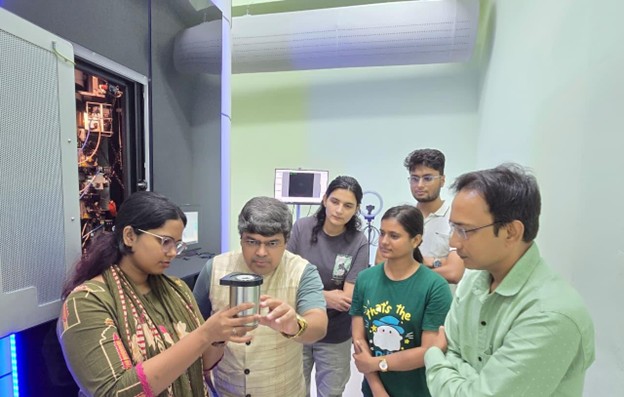
IIT Kanpur also contributed to visualising how one of these designed miniproteins attaches to the CXCR4 receptor. Using a powerful imaging technique called cryo-electron microscopy at its cryo-EM facility, researchers could see exactly how the two molecules fit together and how the miniprotein affects the receptor.
The research was led by the laboratory of Prof. David Baker, who had won the Nobel Prize in Chemistry in 2024. Prof. Arun K. Shukla’s from IIT Kanpur was a major contributor, with his team of researchers Dr. Ramanuj Banerjee, Manisankar Ganguly, Annu Dalal, Sudha Mishra, and Shachie Sinha contributing the study.
The IIT Kanpur component of the research was supported by the Anusandhan National Research Foundation (ANRF), Department of Biotechnology (DBT), and Lady Tata Memorial Trust.
The findings of the study reveal that AI-based protein design is a practical tool for drug discovery. While these specific proteins are not medicines yet, and years of further testing lie ahead before it reaches the clinic, the study offers a workable method for designing targeted, protein-based treatments for receptors that have been difficult to target with drugs.
About IIT Kanpur
The Indian Institute of Technology Kanpur, established in 1959, is recognised as an Institute of National Importance by the Government of India. Renowned for excellence in science, engineering, and interdisciplinary education, IIT Kanpur spans a 1,050-acre lush green campus and comprises 20 departments, 27 centres, three interdisciplinary programmes, and three specialised schools. With over 570 faculty members and more than 9,500 students, the institute continues to lead in innovation, research, and holistic development.
For more information, please visit: www.iitk.ac.in
