

Dr. S. G. Srivatsan
(PhD/CHM/2003)
Prof. Srivatsan is currently a Professor in the Department of Chemistry at the Indian Institute of Science Education and Research (IISER), Pune.
Profile
Prof. Srivatsan obtained his Master's degree from IIT Madras in 1997 and later earned his Ph.D. from IIT Kanpur in 2003 in Chemistry. He joined IISER Pune as an Assistant Professor in November 2008 and was promoted to Associate Professor in December 2014. In his present role, he continues to contribute significantly to teaching, research, and academic leadership at the institute. He is also the recipient of an international award recognizing the most outstanding Ph.D. thesis in the field of Chemical Sciences.
Alongside his academic responsibilities, Prof. Srivatsan has undertaken key administrative responsibilities at the institute. He served as Associate Dean for Research and Development from 2019 to 2021, supporting the growth of research initiatives and infrastructure at IISER Pune. Earlier, from 2016 to 2019, he served as Associate Dean of the Committee on Student Activities (COSA), where he played a role in shaping student-focused programs and activities at IISER Pune.
His research interest lies in developing tools to assess the structure, dynamics, and function of nucleic acids in cell-free and cellular environments. He initiated a research program to design structurally non-perturbing, conformation-sensitive nucleoside probes to study nucleic acids in real time by fluorescence, in 3D by X-ray crystallography, and in cells by NMR. Some of these nucleoside analogs have been utilized in developing assays to detect nucleic acid damage, monitor drug binding, and study the structure and recognition properties of non-canonical nucleic acid structures such as G-quadruplexes and i-motifs.
He is also developing the chemo-enzymatic strategies for nucleic acid functionalization using bioorthogonal chemistry, including RNA labeling and imaging with azide- and alkyne-modified UTP analogues. These analogues are incorporated by endogenous RNA polymerases and post-transcriptionally labeled with a variety of probes by click and Staudinger ligation reactions. Recently, the approach has been extended to remodel CRISPR guide RNA using terminal nucleotide transferase to display small molecules at specific gene targets.
Achievements and Honors
- Fellow of the Indian Academy of Sciences, Bengaluru, India (2026)
- Fellow of The National Academy of Sciences (NASI), Prayagraj India (2025)
- Editorial Board member of Zeitschrift fur Naturforschung C-A Journal of Biosciences, since January 2025
- Alexander von Humboldt Renewed Research Fellowship, University of Konstanz, Sponsored by AvH Foundation, Germany, May 01, 2023 - July 31, 2023
- National Prize for Research on Chemistry of Peptides and Nucleic Acids, Sponsored by CNR Rao Education Foundation, 2020
- Chemical Research Society of India (CRSI) Bronze medal, 2020
- Sun Pharma Research Award in the Pharmaceutical Sciences, 2020
- National Prize for Research on Chemistry of Peptides and Nucleic Acids Sponsored by Prof. C.N.R. Rao Education Foundation, 2020
- Chemical Research Society of India (CRSI) Bronze medal, 2020
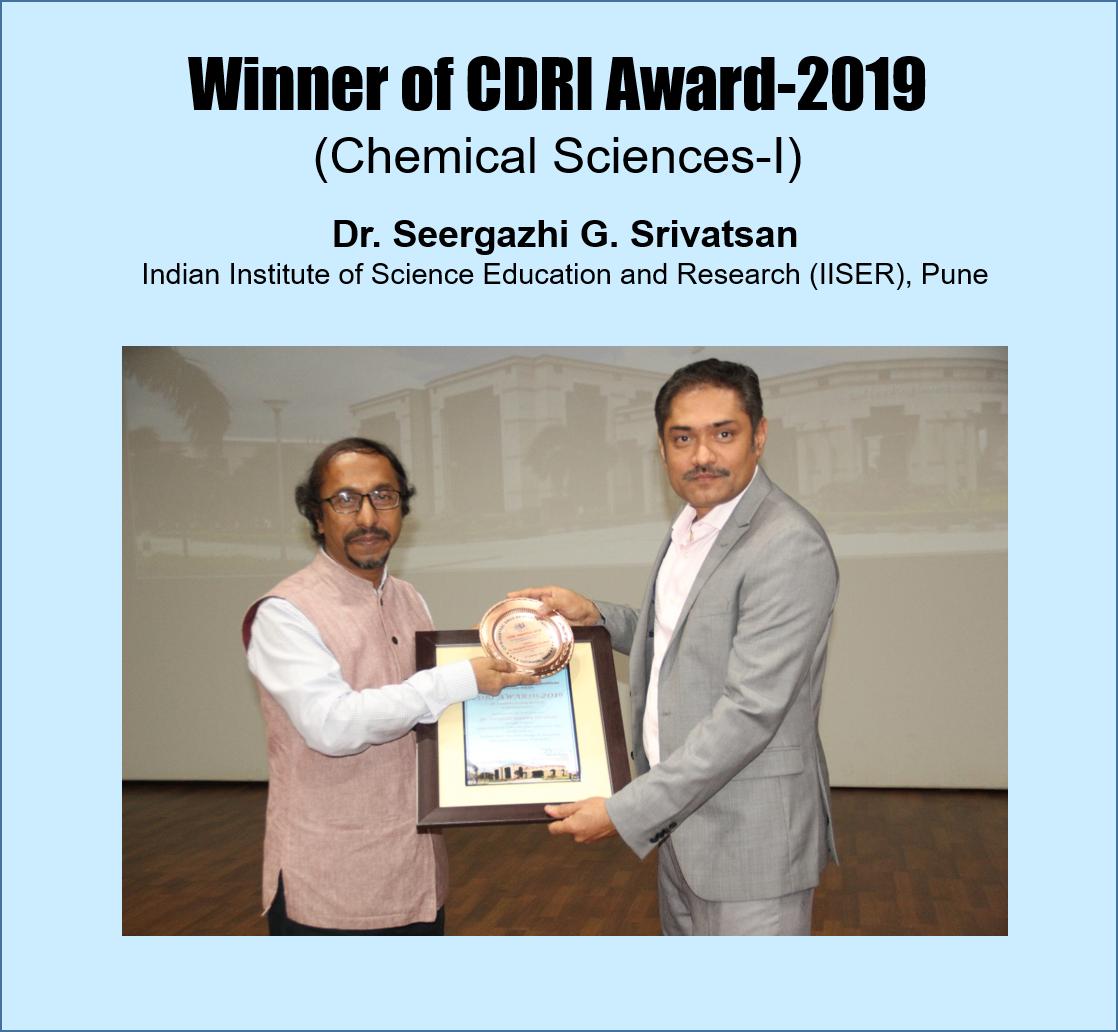
- CDRI awards for Excellence in Drug Research, 2019
- Alexander von Humboldt Renewed Research Fellowship, University of Konstanz, Sponsored by AvH Foundation, Germany, May 10, 2019 - August 07, 2019
- Editorial Advisory Board member of ACS Bioconjugate Chemistry, since January, 2019
- Wellcome Trust-DBT India Alliance Senior Fellowship 2016-2021
- Alexander von Humboldt Renewed Research Fellowship, University of Bonn, Sponsored by AvH Foundation, Germany, May 10, 2016 - August 08, 2016
- The Wellcome Trust Fellow, 2015
- Emerging Young Scientist in India Award, given at Chemical Frontiers Conference (August 2014), presented by Bharat Ratna Prof. C. N. R. Rao
- RSC West India Section: Early Career Scientist award 2012
- IUPAC Prize for Young Chemists, 2004
- Alexander von Humboldt Postdoctoral Fellowship, Germany, 2003-2005