Others Initiatives

Cell for Differently Abled Persons (CDAP)

Instituted through the generous donations from Mr. Ranodeb Roy (BT/CSE/1990), the Ranodeb Roy Student Disability Program (RRSDP) aims to enhance the learning experience for students with disabilities at IIT Kanpur by facilitating access to assistive technologies, software, and devices. Strengthening this commitment, the Brisk Electronic Pvt Ltd (BEPL) project, supported through an endowment fund by BEPL in 2024 and led by the DORA office, further expands the availability and utilization of such resources on campus. The donated funds are also used to provide assistant services and initiate transport facilities for differently-abled students, reinforcing the institute’s vision of an inclusive and supportive academic environment.

Cell for Differently Abled Persons (CDAP) has been proactive towards a barrier free campus since its establishment in 2017. The Cell acts as the first point of contact for differently abled students. Over the past four years, CDAP team comprising of faculty, staff and students has worked tirelessly towards its vision to provide a wholesome productive environment to our differently abled students. CDAP efforts are supported by the Counseling Services, Health Center, of Dean of Academic Affairs, Dean of Students’ Affairs, Dean of Resources and Alumni, and many other entities on the campus.

The vision of CDAP is:

  • To provide condusive environment for differently-abled employees, students, and other workers of the Institute.
  • To work as a single window to cater to the needs of the differently-abled people.
  • To coordinate with all the officies/departments to address arious issues related to the differently-abled persons. Several initiatives are undertaken from time-to-time on campus including infrastructure upgrade, such as making the campus more accessible by building ramps under the Accessible India Campaign. Further, working in collaboration with the Health Center on the campus has ensured increased assistance along with medical treatment of the physically challenged people.

Research for Assistive Technology at IIT Kanpur

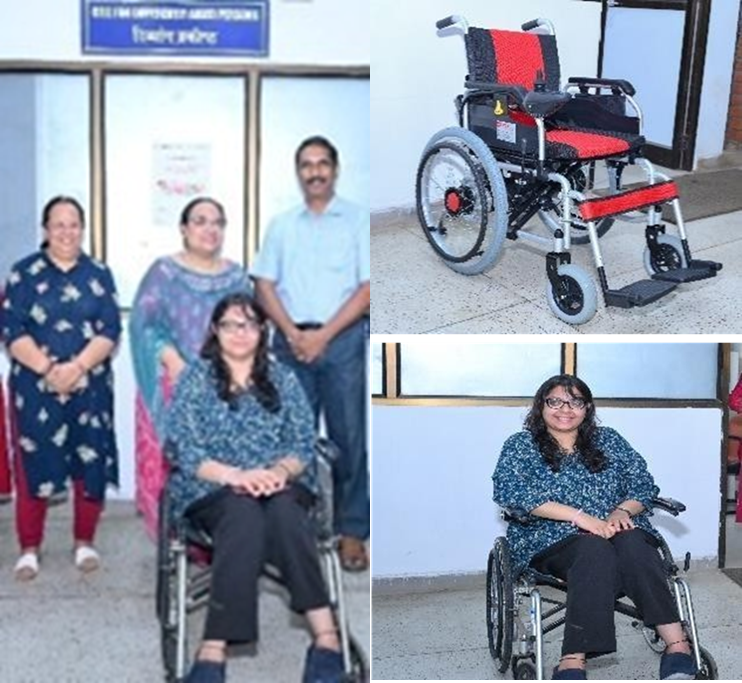
A postgraduate (M.Sc) student who earlier relied on a manual wheelchair and caretaker support now navigates the campus independently with an electric wheelchair provided under CDAP. This intervention has significantly improved her mobility, comfort, and participation in academic life.

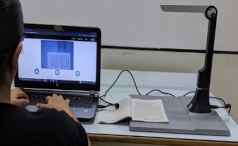
A KIBO assistive reading device has been installed at the library to support visually impaired students. KIBO enables users to instantly convert printed or digital text into audio, allowing them to independently access books, documents, and academic materials available in the library.

Haptic Tactile Watch for the Visually Impaired

Haptic Watch
Haptic Tactile Watch

Developed by Prof. Siddharth Panda and Mr. Vishwaraj Srivastava (National Center for Flexible Electronics)
The invention relates to a touch-sensitive tactile watch for the blind and visually impaired that provides haptic based feedback using vibrations. The user has to scan the tactile hour indicators through touch and time will be displayed using vibrations. The watch is able to sense if the user touches and scans the tactile hour indicator. Based on this information, special patterns of vibrations are made and the user is able to understand the time of the day. The watch communicates the time to the user via vibrations. The invention provides the visually impaired person a good digital watch.

Upper Limb Prosthetic Hand

Prosthetic Hand
Upper Limb Prosthetic Hand

Developed by Mr. Nishant Agarwal (The Life & Limb Factory, IIT Kanpur)
The Upper Limb Prosthetic Hand is a functional prosthesis with five grip patterns that can achieve more than 15% of the activities of daily living. Conventional practices require frequent hospital visits if one follows the old method of making prosthetic socket which involves measurement and casting, modification of mould, creating the test socket, fitting and adjusting, and finally laminating all these steps require user engagement to proceed. However, the new method of remote fitment allows one to limit user engagement to only a single point where a 3D scanner is used to acquire patients' data. The scan is then digitally manipulated and prepared for 3D printing. The Upper Limb Prosthetic Hand weighs less than 500 grams with the battery pack. The socket is digitally fabricated and requires minimal user engagement.

Two-way Communicator for the Deaf, Mute and Blind

Two-way Communicator for Deaf, Mute and Blind

Developed by Mr. Praharsh Tiwari
The product provides a platform for a deaf-blind person to communicate efficiently through hands. The system includes a set of gloves connected to a computer. It is based on the Indian system of counting, adding and subtracting two or more numbers. The product utilizes Morse code and works on the principle of the Indian system of counting. Indians use creases on their fingers to count numbers. The user would use his/her hands as a keyboard by using his/her thumb to touch contacts placed on her/his gloves precisely to form the creases on his/her fingers. For outgoings communication, the idea is to replace the numbers with alphabetical letters starting from the bottom most crease on the left hand’s finger and going till the 26th crease in the alphabetical order (tips of the fingers included). For incoming communication, ordinary speech would be converted to text and further into Morse code by the computer mounted on the system. There are glove vibration in the form of Morse Code.