Indian Institute of Technology KanpurIIT Kanpur
सतत ऊर्जा अभियांत्रिकी विभागSustainable Energy EngineeringIndian Institute of Technology Kanpur

Research

How our research is organized, and who works on what.

Our research is grouped into five verticals: how energy is generated, stored and distributed, how the energy transition is modelled and governed, and how critical materials are recovered and recycled.

The verticals overlap, and many faculty work in more than one. They come from science, engineering and policy backgrounds, including joint faculty from Aerospace and Civil Engineering. The work includes both basic research and the building of prototypes.

Energy generation

This vertical covers new photovoltaic materials (perovskite, organic and tandem solar cells), solar thermal and thermochemical systems, wind energy and aerodynamics, fuel cells and green hydrogen.

Solar photovoltaicsSolar thermalWind energyFuel cellsGreen hydrogen
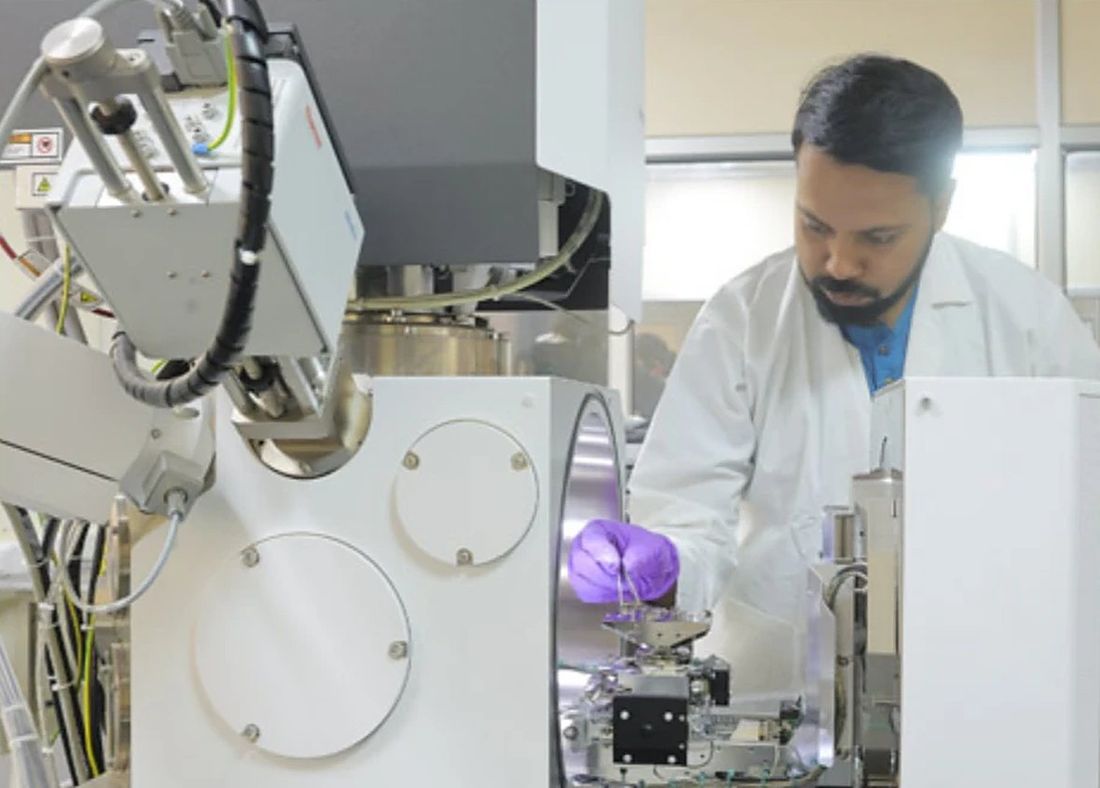
More uniform perovskite films for tandem solar cells

Adding a small amount of ammonium chloride changes how wide-bandgap perovskite films crystallize, suppressing unwanted phases and giving more homogeneous films. Solar cells made this way reached about 18% efficiency. The aim is a perovskite top cell for tandem solar cells.

Ashish Garg, Srinivas Karthik Yadavalli · Advanced Science, 2025
Energy storage

Work here includes solid-state and next-generation batteries, supercapacitors, modelling of electrochemical storage, solar thermal storage, and capturing carbon dioxide for storage or use.

BatteriesSupercapacitorsSolar thermalCarbon capture, utilization and storage
Making thin lithium metal affordable for solid-state batteries

Solid-state lithium metal batteries could store far more energy than today's lithium-ion cells, but they need very thin lithium foils. This study compares ways of making them at gigafactory scale, identifies thermal evaporation as a potentially cost-effective route, and estimates the resulting battery pack costs.

Sudarshan Narayanan · Nature Energy, 2024

Energy distribution

Topics include hybrid AC-DC microgrids, smart grids, connecting renewables to the grid, electricity markets, and power electronics for electric and fuel cell vehicles.

Smart grid and microgridPower distributionElectric mobilityElectric vehicles
A high-gain power converter for fuel cell vehicles

A boost converter built from switched inductors and switched capacitors, designed to step up the voltage of a fuel cell for use in electric vehicles.

Amarendra Edpuganti, Prabodh Bajpai · IEEE Journal of Emerging and Selected Topics in Industrial Electronics, 2026

Energy modelling & policy

Faculty in this vertical work on energy and climate policy and regulation, climate modelling and air pollution, decarbonizing industry, and net-zero buildings (metering, occupant behaviour and indoor air quality).

Energy policyClimate modellingDecarbonizationNet zero
Where the emissions are in Indian steelmaking

A process-by-process analysis of emissions from the blast furnace and basic oxygen furnace route in India's iron and steel industry, with a pathway for decarbonizing it.

Deepika Swami · Journal of Environmental Management, 2024

Critical materials & recycling

This vertical deals with critical minerals such as lithium, cobalt, nickel and the rare earths: securing their supply, recovering them from electronic, battery and solar panel waste, and the materials and processes of a circular economy.

Critical mineralsUrban miningE-waste recyclingCircular economyMaterials for clean energy
Recovering battery metals by fast crystallization

Fast crystallization recovers nickel, manganese and cobalt together, as mixed sulfates, from spent lithium-ion batteries. The method could be used for recycling at large scale.

Vivek Verma · Resources, Conservation and Recycling, 2026

Page last updated 6 November 2026Suggest a correction

Study, partner, recruit or visit

Apply