jayantks@iitk.ac.in
Highlighted are some of the recent publications that have emerged from our user lab facility, showcasing our commitment to advancing user-centric research and design. These publications represent just a glimpse of the impactful work happening in the ChE department using equipments of JBCOESC facility.
Abstract: Poly(dimethylsiloxane) (PDMS) has been used extensively for making microfluidic devices because of several favorable features: optical transparency, bio-compatiblity, easy moldability and its inertness towards most materials. However, PDMS is non-biodegradable and swells in contact with most solvents. It is also an expensive chemical. As an alternative to PDMS, here we have presented application of poly(glycerol sebacate) (PGS), a thermoset elastomer for fabrication of micro-channels. PGS is made using condensation reaction of a non-edible vegetable oil and glycerol which allows the Young's modulus of PGS elastomer to be varied over wide range: 0.125 -1.4 MP. PGS is also flexible, biocompatible and optically transparent. We have employed controlled etching with an aqueous solution of NaOH to make micro-channels of a variety of shapes, sizes and complexities on PGS. We have made straight and spiral channels and ones with patterned surface of the channel wall and depth. The PGS surface shows hydrophobicity initially but turns hydrophilic over time, with minimal swelling effect, thereby highlighting its suitability for both aqueous and non-aqueous media. Its compatibility with physiological conditions too is demonstrated by flowing buffer solutions of acidic and neutral pH and then carrying out UV-Vis analysis of the discharge liquid to show negligible leaching from the channel wall.
Read More ...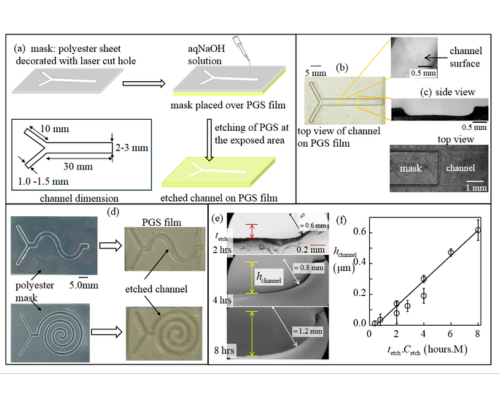
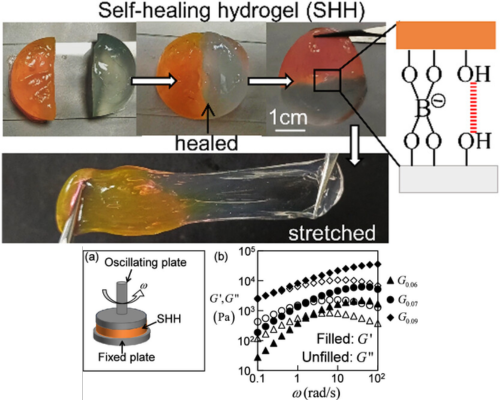
Abstract: Bonding hydrogels with silicone elastomers may allow fusion of the conductivity and biodegradability of hydrogels with the mechanical integrity and flexibility of silicone, which is desirable for many applications in flexible electronics, ionotronics, and microfluidics. However, hydrogels do not bond with silicone unless both materials are suitably functionalized. We show here that a two-phase composite (TPC) glue prepared by blending a self-healing hydrogel (SHH) made of starch, PVA, and borax with silicone forms a bridge between the two materials, eliminating the need for surface and bulk modification processes. The glue was made by dispersing drops of the SHH in silicone, followed by forming a thin layer of this dispersion on a typical silicone surface. Curing the dispersion bonds it with the latter. To bond a hydrogel to this glue, its top surface was removed mechanically or chemically to expose the gel phase to the surface, on which the SHH prepolymer mix was cross-linked. The SHH microparticles in the glue acted as anchors for the SHH layer to bond to it; the silicone phase of it at the other side bonded to the elastomeric layer, thereby creating a strong attachment between the two. The bonding strength of the SHH–TPC interface was estimated via pull-off experiments, which revealed that the debonding force scales as n1/3(xpxM2/3)g2/3, where n is the number of SHH particles in the TPC, g is the SHH weight fraction in the TPC, and xp and xM are the solid contents in the SHH in TPC and the SHH layer, respectively. The SHH–glue interface also exhibits reversible bonding/debonding for multiple cycles.
Read More ...