The 2001
Bhuj Earthquake-
I.I.I.Kanpur
Dedicates NICEE to the Nation

 |
Picture
Perfect
it
was, till the earthquake brought down one block of this six-storey reinforced
concrete building in Anjar town!! |
The Quake…
Once again the I.I.T.Kanpur team
of nine earthquake engineers, geophysicists and students set out on yet another
journey chasing earthquakes to learn important lessons and document for future.
This time it was after the powerful earthquake that struck the Katch area in
Gujarat at 8:46am on 26 January 2001, the most damaging earthquake in the last
five decades in India. The team studied the seismic performance of buildings,
bridges, dams and other modern industrial constructions. This M7.7 earthquake centered near Bhuj is the
first to hit metropolitan cities of the country. Therefore, the performance of
structures in this area offer important lessons particularly from the points of
view of efficacy of Indian codes and construction practices.
The earthquake has pointed out severe
inadequacies in the current construction practices of reinforced concrete
multi-storey buildings that are so commonly being built in all urban areas in
the country. Also, many earth dams have failed providing very useful case
histories that will further our understanding on seismic design of earth dams.
Further, the port structures, the railway facilities, and the highway
structures including bridges suffered major losses. Most conspicuous of the
losses in this earthquake are the heritage/monumental structures; many of them
are lost forever.
A detailed account of the origin
and effects of the earthquake, and the causes of structural failures is
currently under preparation. The above investigation was supported by the
Earthquake Engineering Research Institute (USA) and the Department of Science
and Technology (Government of India). Professor Sudhir K. Jain of IIT Kanpur
lead a team of 15 investigators consisting of scientists, engineers and an
emergency manager from India and USA, jointly with Dr. William Lettis of
William Lettis Associates, USA, to conduct a reconnaissance of the
earthquake-affected area.
Earthquake Engineering at IIT Kanpur
IIT Kanpur has been at the mission to move towards
an “earthquake-resistant” country and to develop preparedness for facing the
upcoming earthquakes in the country, through both short term and long term
actions. Notable amongst these are:
-
Development
of a strong R&D programme in earthquake engineering over the past decade
and a half with (i) over 20 sponsored research projects on
earthquake engineering from leading national agencies; (ii) a
state-of-the-art earthquake engineering facility for imparting education to
post-graduate students and professionals interested in earthquake
engineering; and (iii) 4 PhD graduates (2 in progress) and 50 M.Tech.
graduates (6 in progress) in the past decade and
a half.
-
Strong contribution to the
development of Indian Standards on earthquake design of structures, as principal authors of four comprehensive codes on seismic design of ductile
detailing of RC structures, buildings, bridges and liquid retaining structures;
the first was published in 1993, the second is expected to be released anytime,
and the other two are in the discussion stage;
-
Development
of a very successful
continuing education program for practicing professionals (engineers, architects and engineering decision makers) in earthquake design of buildings
and bridges; over 1400 of them have been trained so far over the past 8 years;
and
-
Setting-up of the National
Information Center of Earthquake Engineering at IIT Kanpur with a view to collect and maintain information resources on
Earthquake Engineering and make these available to the interested
professionals, researchers academicians, and others with a view to mitigate
earthquake disasters in India; this center is supported by the generous funds
from AICTE, Department of Telecom, Railway Board, Department of Atomic Energy,
Ministry of Agriculture and HUDCO, and by generous contributions from EERI
(USA), MCEER (USA), PEER (USA) and individuals.
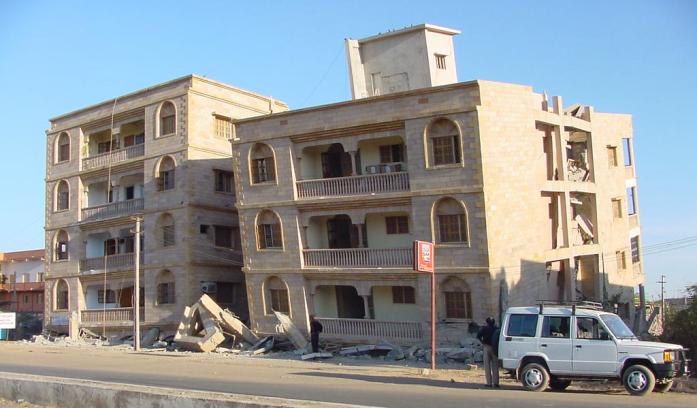 |
No
Storey ... is the Story
The building on the left lost
one storey and that on the right lost two...!! |
|
|
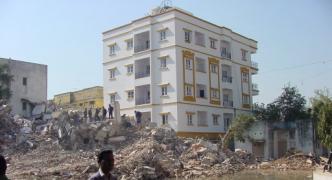
...only a pile of rubble is left from
many buildings |
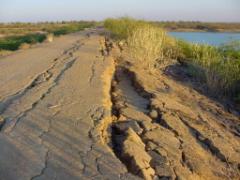
...failed earth dam at Fatehgad
|
|
|
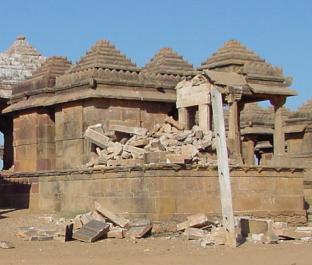
Many heritage structures are lost....
forever!!
|
Initiatives of IIT Kanpur and its Alumni after 2001 Quake
After the devastating 2001 Bhuj earthquake, a severe shortage was felt of trained structural
engineers in the region who can assess the damages and suggest measures for
repair/seismic retrofit of the damaged and other buildings. IIT Kanpur took a few initiatives, both short term
and long term, to address this immediate technical need of the state of Gujarat
in particular and the nation in general. These initiatives include:
-
Immediately on the occurrence
of the event, the Institute formally launched a web site (www.nicee.org) of the National Information
Center of Earthquake Engineering (NICEE) at IIT Kanpur to provide immediate
guidance to engineers on information pertaining to the repair and retrofit of
earthquake damaged buildings. A document published by the International
Association for Earthquake Engineering (IAEE) title “Guidelines for
Earthquake Resistant Non-Engineered Constructions” was made available on
the web site (with permission from IAEE). Also, the documented experiences in
the major reconstruction activity embarked by the Government of Maharashtra
after the 1993 Killari Earthquake were also provided on the web site (with
permission from EERI) for the benefit of decision makers and engineers who are
likely to be involved in the upcoming reconstruction activity in Gujarat.
-
IIT Kanpur has been conducting numerous short-term
courses for training practicing engineers on seismic design of reinforced
concrete buildings and bridges over the past 8 years. Until now over 1400 of
them have been trained in the country. Two of these engineers based in
Hyderabad immediately moved into Ahmedabad immediately after the earthquake and
spent a week there providing guidance to the local engineers and administrators
on buildings related issues arising out of the earthquake. Since then, more
professional engineers trained by IIT Kanpur in the past have been extending
help to local authorities.
-
Four of the past
post-graduates of IIT Kanpur with specialty in earthquake engineering, who are
currently employed in leading engineering institutions/companies in the
country, volunteered and visited the towns of Jamnagar, Morbi and Surendranagar
and provided some guidance and suggestions to local engineers and
administrators on handling of earthquake damaged buildings. Their effort was
coordinated by CMAG (City Managers Association of Gujarat), an NGO based in
Ahmedabad.
-
Another former post-graduate
student of IIT Kanpur with specialization in Earthquake Engineering and now a
consulting engineer in New Delhi was sent to Ahmedabad to train a small group
of engineers on computer analysis of multistory buildings for earthquake
forces. This was done in collaboration with Nirma Foundation at Ahmedabad.
-
Professor Sudhir K Jain
conducted two seminars in Ahmedabad, one at the NIRMA Institute for Technology
and the other at Institution of Civil Engineer and Architects; these were
attended by over 300 engineers/architects. Professor Jain provided insights
into the performance of structures, and the steps required to be taken in the
aftermath of the quake.
-
The IIT Kanpur team held
numerous meetings with the administrators of the Ahmedabad, Rajkot and Jamnagar
to sensitize them of the gravity of the situation and provide them with
critical inputs to handle the situation.
-
Just as Ahmedabad, the City of Kanpur is itself
situated in the seismic zone III, the moderate zone after the more severe
seismic zones V and IV. The Institute in collaboration with the Institution of
Engineers (India), Kanpur Local Centre, is conducting an awareness program in
April 2001 for Architects, Builders, Consultants and citizens of Kanpur, to
give them the necessary support to face the threat of earthquake shaking in the
region.
Dedicated to the Nation…
IIT Kanpur remains
committed to the cause of improving earthquake safety in our country and will
take more initiatives in the future also to strengthen the country’s capacity
to handle earthquakes with minimal loss of life and property, and dedicates the
National Information Center of Earthquake Engineering (NICEE) hosted at
IIT Kanpur, to the nation…
|
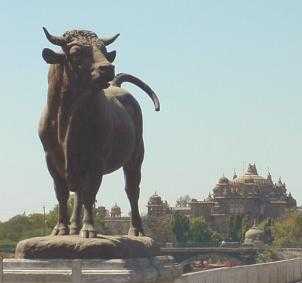
NICEE - bullish on information sharing
...!!
(The picture was
taken after the earthquake at the town of Morbi in Gujarat;
the Palace in
the background was severely damaged during the earthquake.)
|

C.V.R.Murty
Department of Civil Engineering
Indian Institute of Technology Kanpur
|