Current Research:
Process Intensification: : Chemical process industries employ equipments which bear striking resemblance to the glassware used in chemistry laboratories. Some do feel that the glassware have been merely scaled-up. Innovative use of modern fluid mechanics, heat and mass transport can lead to miniaturization of chemical plants as it is happening with computers. This is commonly referred to as Process intensification. It aims at achieving a volume reduction of 10-1000 times. Our work focuses in volume reduction and enhancing the attainable purities in distillation, adsorption, absorption and extraction.
1) Higee (or rotating packed bed) distillation
2) Trickle-Bed Reactors
3) Simulated Moving-bed (SMB) Gas-Solid processes
4) PSA for Separation of Gas mixtures
5) Duplex PSA
6) Absorption
7) Extraction
8) Simulation and design of Multicomponent Separation Processes
1) Higee (or rotating packed bed) distillation:
The developmental work on HIGEE is going for the past two decades. Recently Dow Chemical Company USA has used it for the production of HOCl. However, it has not gained wide acceptance. The primary reason appears to be the lack of understanding of the transport processes.
We have shown that the tangential slip velocity between the gas and the packing in the rotor is negligible. Therefore, there would be no enhancement in the gas-phase mass transfer. Therefore, in a process like distillation in which the controlling resistance is in the gas-phase, the conventional Higee may not lead to much process intensification.
We proposed a novel design in which the slip velocity ranges from 20 to 5m/s. The design allows high throughputs and permits incorporation of stripping and enriching sections in a single rotor. Further, the size of the rotor is small enough to place it in either in the reboiler/condenser or both as shown in the pictures and figures given below. We are examining its use in air-breathing hypersonic vehicles. A patent pending is on this novel design.
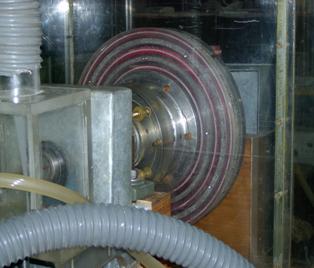
Laboratory RPB unit
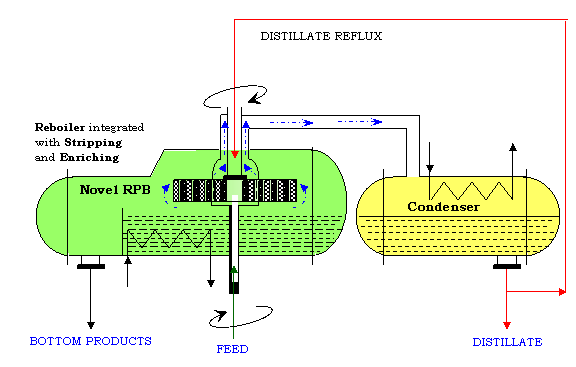
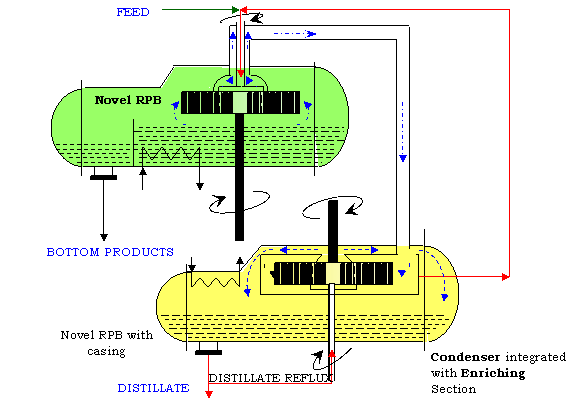
Columnless distillation units
2) Trickle-Bed Reactors:
The possible intensification of reaction rates in Rotating Trickle-bed Reactors is under investigation. The high centrifugal field permits the use of packing with surface area as high as 5000 m2/m3 (Recemat® International, Holland; www.recemat.com) compared to that of catalyst bed 1000 m2/m3. When the controlling resistance is on the gas side, the reactor size can be brought down by 20-60 times.
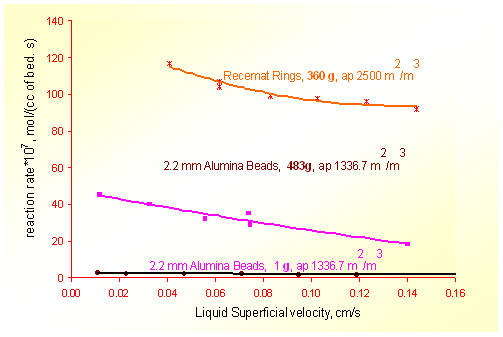
Laboratory Trickle Bed Reactor unit Enhancement in reaction rates for the Hydrogenation of α-methyl styrene
3) Simulated Moving-bed (SMB) Gas-Solid processes
The countercurrent fluid-solid processes offer several advantages over fixed beds in heat exchange between gases, separation by adsorption, simultaneous reaction and separation processes. Earlier attempts for commercial exploitation failed due to difficulties in solid handling and attrition of particles. UOP succeeded in realizing the simulated moving bed (SMB) employing a fixed bed. Several of their units are in operation for the separation of liquid mixtures around the world.
We came up with moving-port systems to achieve simulated moving bed operation. A schematic of one such system is given below. It has an inner tube with a straight slot and an outer tube with a helical slot. Where these slots intersect forms a rhombus shaped port or opening. If one of these tubes is rotated, the port moves from one end to the other and returns abruptly. The stepper motor can be used to rotate the outer tube. The inner tube can be connected to a fluid line. A fluid can be introduced or withdrawn through the port. Introducing or withdrawing fluid through a port amounts a ‘point’ feed or withdrawal.
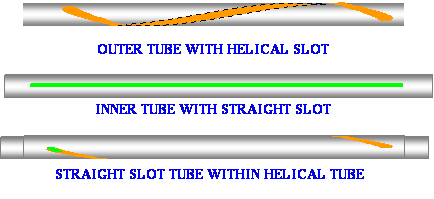
Helical-type moving-port system
Work is in progress on:
Ø Heat exchange between two gas streams using a fixed bed of solids, as an alternative to the compact heat exchangers or heat regenerators.

Laboratory SMB heat exchanger unit
Ø Fractionation
of gas mixtures is possible using simulated moving-bed absorbers with raffinate
and extract refluxes, and pressure/thermal swing for regeneration. An ideal SMB
adsorber for gas fractionation is shown below. The stripping and enriching
sections are identical to their counterparts in distillation. The blowdown and
the presaturation sections are functionally identical to the reboiler and the
condenser in distillation.
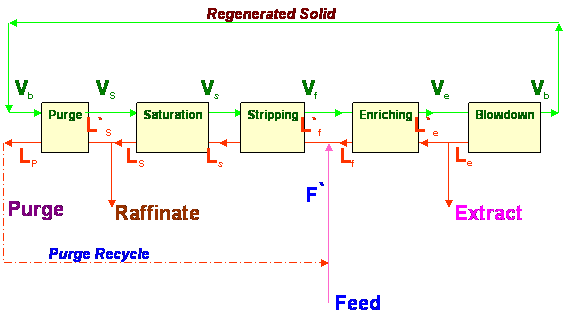
Ideal moving-bed gas fractionator
The performance of the ideal moving bed adsorber is shown on the McCabe-Thiele
diagram given below. 
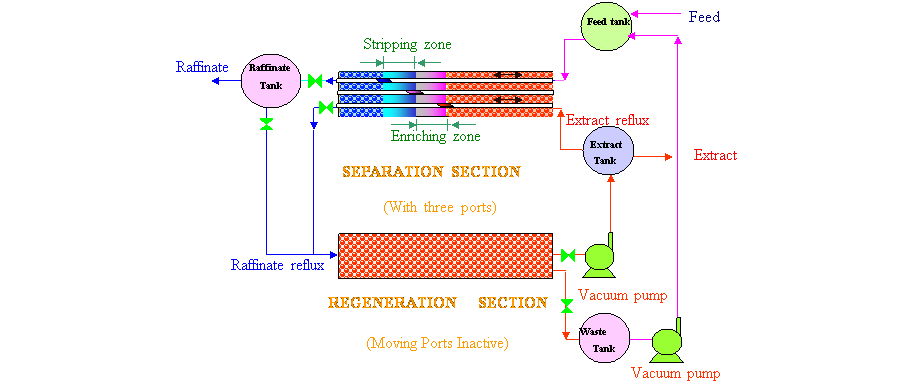
Proposed two bed SMB gas fractionator
Ø The above unit can be used reactive separation.
International patent pending for IIT Kanpur and GAIL (INDIA) Limited
4) PSA for Separation Gas mixtures :
The understanding of the role of reflux in adsorptive separation can lead to high purity products. We have designed a 4-bed PSA cycle taking the role of reflux into account. The computer studies shows that it is possible separate any gas mixture into high purity products without a waste stream. Table below presents some results of its simulation.
Ethane-methane on Silicalite zeolite
PARAMETERS: T= 298°K; PH = 1 atm; PL = 0.1 atm; Purge reflux ratio = 0.5; Bed length = 1 m; Bed diameter = 2.5 cm, Xf = 0.5
|
Feed |
% Purity |
Productivity (mol/kg-h) |
|||
|
SLPM |
Extract (mol % of C2H6) |
Raffinate (mol % of CH4) |
C2H6 |
CH4 |
|
|
1.34 |
99.70 |
98.32 |
2.03 |
2.03 |
|
|
1.61 |
99.53 |
99.38 |
2.43 |
2.42 |
|
|
2.02 |
99.53 |
99.45 |
3.04 |
3.04 |
|
|
2.42 |
99.42 |
99.36 |
3.64 |
3.64 |
|
|
2.69 |
97.76 |
97.65 |
3.97 |
3.97 |
|
The bar chart below provides a comparison with recently reported studies with the performance of the ideal adsorber and the four-bed PSA cycle.
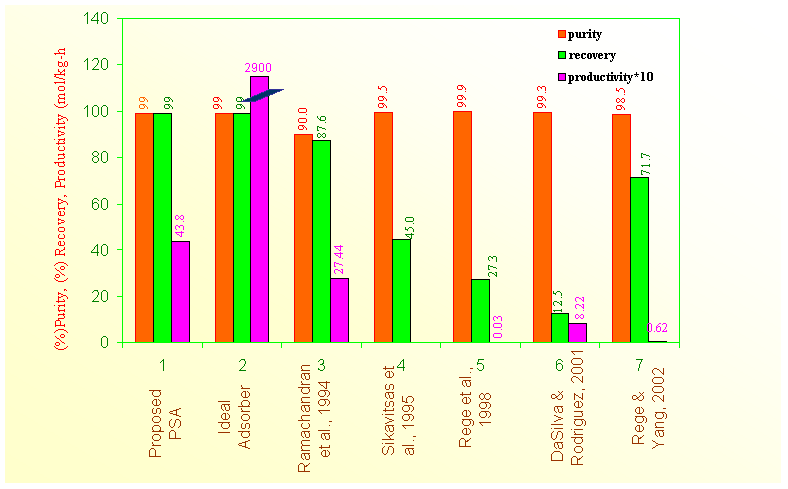
Purity, recovery and productivity of the ideal adsorber and the 4-bed PSA compared with literature
for the fractionation of propylene-propane system.
The figure given below shows US$ 200,000 PSA experimental skid to validate the proposed 4-bed PSA. This work is being under a grant of Rs 18 million from GAIL (India) Ltd.

Laboratory Four Bed PSA Unit
The PLC cabinet of the laboratory Four Bed PSA Unit
5) Duplex PSA
A new PSA has been proposed by Leavitt (UOP patent) and Hirose and coworkers (Japan) using 2 beds. This is known as Duplex or Dual Reflux PSA. It employs a separation mechanism that is rather unique. It operates with moderate pressures unlike conventional PSA. We have modified the Duplex PSA for bulk separation of to obtain high purity products. Table shows some typical results. Work is in progress on thermal swing Duplex process.


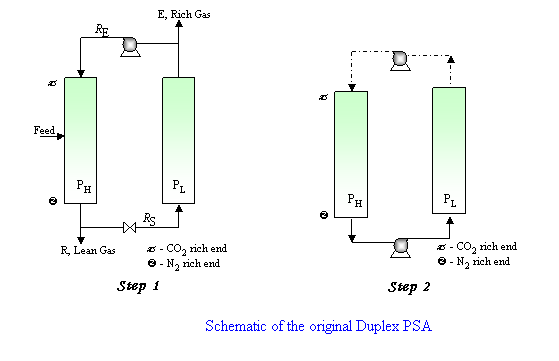
Comparison of Original and Modified Duplex (N2-O2 on 13X zeolite)
PARAMETERS: T = 298K; PH = 4 atm; PL = 1.5 atm; Purge reflux ratio = 1.0; Bed length = 1 m; Bed diameter = 2.5 cm, XfN2= 0.5
ORIGINAL DUPLEX
MODIFIED DUPLEX
Feed (SLPM)
% Purity
Productivity (mol/kg-h)
Feed (SLPM)
% Purity
Productivity (mol/kg-h)
Extract (mole % of N2)
Raffinate (mole % of O2)
N2
O2
Extract (mole % of N2)
Raffinate (mole % of O2)
N2
O2
2.15
69.0
69.1
5.03
5.01
1.79
98.9
99.2
6.05
5.97
3.23
72.2
72.2
7.90
7.88
2.69
99.1
99.5
9.10
8.92
4.30
73.5
73.5
10.73
10.70
3.58
97.6
97.1
11.83
11.84
5.38
73.1
73.2
13.35
13.32
4.48
95.8
95.1
14.46
14.54
NOMENCLATURE: T - Operating temperature; PH - Adsorption pressure; PL - Desorption pressure; Xf - Feed composition
6) Absorption
The above 4-bed and 2-bed PSA schemes can be used for the bulk separation of gas mixtures by absorption using solvent immobilized in porous solids. The operation of these ‘PSA’ units is comparatively easy, clean and requires less manpower. The work is underway to assess the potentialities of these new methods.
7) Extraction
Fractionation of liquid mixtures using a solvent immobilized in soft foam particles is being explored. This process offers high interfacial area and eliminates flooding. The loaded solvent can be recovered by squeezing the foam (similar to regeneration in adsorption) and it can be recycled after recovering solute by flash or fractional distillation.
8) Simulation and design of Multicomponent Separation Processes:
a) Simulation of Multicomponent distillation column using tray-efficiency matrix based on Stefan-Maxwell approach to diffusion
Computer codes for simulation of multicomponent distillation and absorption are
based on component tray efficiencies. The Stefan-Maxwell theory suggests
that the proper generalization of binary point efficiencies to multicomponent
systems yields point efficiency matrix. These, when converted into
component point efficiencies, become unbounded (may vary from )
looses physical significance. The same is the case with component tray
efficiencies which are deduced from the former.
)
looses physical significance. The same is the case with component tray
efficiencies which are deduced from the former.
We have deduced the tray-efficiency matrix from point efficiency matrix accounting for entrainment and liquid flow pattern on the trays. The well-known Naphtali-Sandholm method has been extended for direct incorporation the tray efficiency matrix. A code has been developed to sizes the column, estimate point and tray-efficiency matrix and simulation of the columns.
The same code can simulate distillation, absorption and extraction tray columns.
b) Design of multicomponent packed columns:
A method is being developed which avoids the usual method of treating packed bed as a tray column.
Collaborators:
Prof M.S. Rao, Dr. A. Bhowal
Doctoral Theses students:
Murthy, Ravindra, Sandilya, Sivakumar.
Masters Students:
Anoop, Amit Kumar, Akilesh, Deepajan, Himabindu, Jayshree,
Krishnamurthy, Mantu Kumar, Muhkerjee, Prasad, Pratheeba, Raghuvanshi, Sai
Kumar, Sridevi, Susmita, Vikas.
Project associates:
Bejoy, Bipin, Padamata, Sumit, Kaushal.