
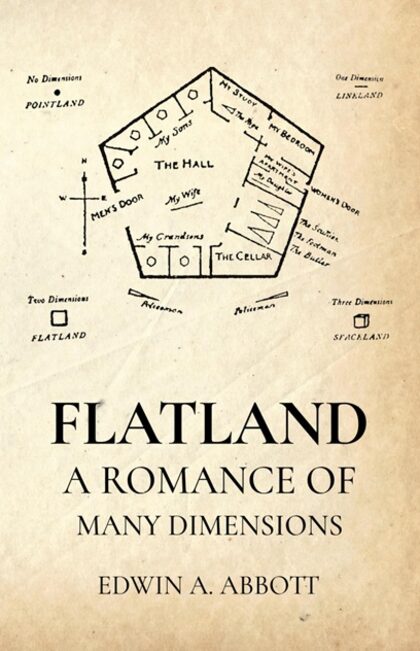
Edwin Abott Abott's Flatland is a short but intellectually rich novella that blends philosophy, mathematics and social satire. This book uses the mathematical idea of dimensions to comment on rigid social hierarchy, blind conformity and fear of unfamiliar ideas which feels both intelligent and oddly relatable. Even though written in 19th century, it still raises questions on society, power and perspective which are relevant even today
The story follows a square, an entity in flatland, a two-dimensional world where shapes define social status. Life is orderly, rigid, controlled and everyone accepts it without any question, until the square begins to experience a world beyond his own.
He dreams of a lineland, which is a one-dimensional world, and then is introduced to another character, sphere from the third-dimensional world who shows him that his perception and apparent reality is limited, and that there is a dimension beyond his understanding. However, when he tries to share this truthwith others in flatland, he is punished, branded a heretic and imprisoned, for challenging the fundamental principles of society.
Flatland is an intellectually challenging novella. It makes one feel uncomfortable in a good way. This book forces us to think about our own rigidity as a society, and how often we tend to reject ideas just because they don't fit into what we already know. It's a short novella, but feels mentally dense and uses allegory to comment on the core issues of society.
This book is meant for readers who enjoy questioning reality rather than just accepting it. If you are someone who is drawn towards abstract thought, philosophy and stories that challenge perception instead of offering comfort, Flatland is a perfect fit for you.